This durability checklist helps you choose a long-lasting football sports bag, basketball sports bag, or sports shoe bag by scoring the real failure zones: strap roots, zipper tracks, base corners, and seam leak paths. Use the 21-point scorecard plus five-minute field tests to confirm zipper fatigue resistance, strap root reinforcement, and a water-resistant base under real load. For shoe storage, prioritise waterproof sports shoe bag seams and interior abrasion resistance so moisture stays contained and your main kit stays dry.
Why This Durability Checklist Exists
A gym bag usually doesn’t “die” in a dramatic way. It quits like a bad teammate: first the zipper starts snagging, then the strap stitches loosen, then one rainy day the base leaks and your clean kit becomes a damp science project. If you’ve ever had a bag fail mid-week, you already know the real cost isn’t the bag itself—it’s the mess, the smell, and the constant “why is my stuff always chaotic?” feeling.
This article is built to solve one thing: how to pick a bag that survives real use, not showroom posing. It’s a practical gym bag durability checklist designed for three types you’re targeting: a football sports bag, a basketball sports bag, and a sports shoe bag that stays tough and reliably water-resistant over time.
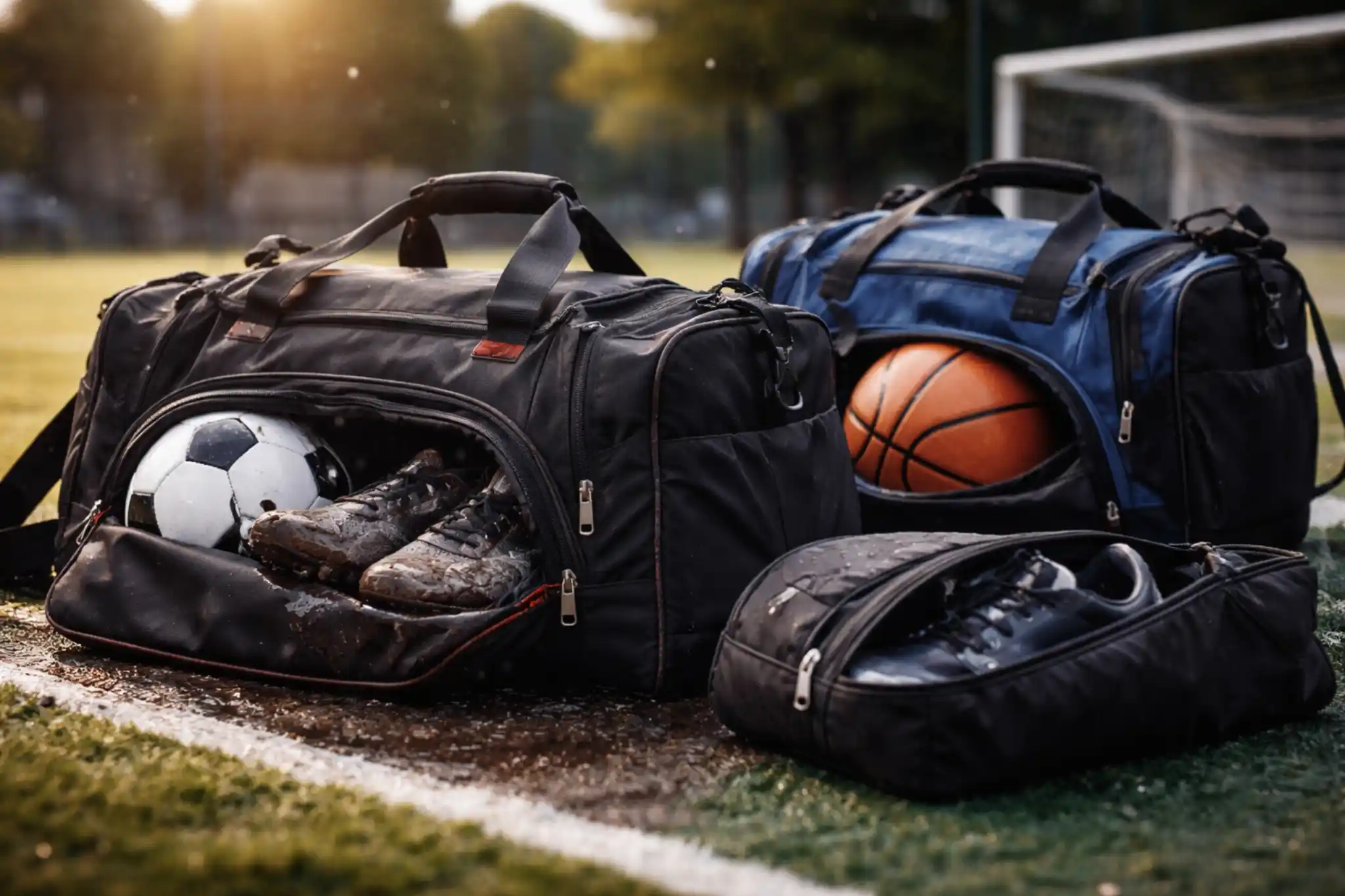
A real-world durability moment: tested gear storage for football, basketball, and wet shoes on the field.
Durability Is Not One Feature It’s a System
Most buyers judge durability by touch: “This feels thick, so it must be strong.” That’s how people buy bags that look tough but fail at the first stress point. Durability is a chain. If one link is weak, the whole bag becomes a future complaint.
Think in three layers:
Structural durability
This is about the load path—how weight travels from the main compartment to the straps and handles. The most common failure points are strap roots (where the strap joins the bag), handle anchors, and base corners. A bag with a thick body but weak strap roots is like a strong car with a cheap steering wheel: impressive until you actually need it.
Hardware durability
Hardware is the part you “use” the most: zippers, sliders, buckles, D-rings, adjustment clips. Even a great fabric can’t compensate for a zipper that snags under pressure. If you open your bag 10–20 times per day, zipper fatigue becomes a real durability metric, not a minor detail.
Real life is wet floors, dusty sidelines, sweaty clothing, and a trunk that sometimes smells like yesterday’s workout. Environmental durability is the bag’s ability to resist abrasion, moisture, and grime without degrading fast.
Here, two phrases matter a lot: water-resistant base and seam leak prevention—especially for your sports shoe bag.
Durability Profiles by Sport Type
The fastest way to avoid buying the wrong bag is to match the sport’s abuse pattern. Football and basketball can use similar-looking bags, but the stress they apply is different. That changes what “durable” really means.
Football sports bag durability profile
A football sports bag often lives in rougher conditions: outdoor fields, muddy patches, wet grass, gritty dust, and the classic sideline chaos. It also tends to get dropped, dragged, and squeezed into car trunks with other gear.
For football, durability is mainly about the exterior and base. Abrasion and moisture are constant. The “best-looking” bag can become the worst one if the base fabric wears thin or the seams start wicking water.
In football, prioritize abrasion-resistant fabric, reinforced base panel, and water-resistant seams.
Basketball sports bag durability profile
A basketball sports bag usually experiences less mud but more repetitive usage. It gets opened constantly: shoes in, shoes out, tape, sleeves, towel, bottle, earbuds, keys—then repeat. Many basketball players also want fast access and easy organization, which means more compartments and more zippers. More zippers means more potential failure.
Basketball durability is about zipper endurance and strap fatigue. If a bag is opened 30 times in one session, the zipper and its stitching are doing serious work.
For basketball, prioritize zipper fatigue resistance, strap stability, and hardware strength.
Sports shoe bag durability profile
A sports shoe bag has a unique enemy: the shoe sole. It acts like sandpaper. Add moisture, sweat, and occasional wet floors, and you have a perfect storm for interior abrasion and seam leaks.
Shoe bags also fail quietly. First the lining scuffs. Then seams begin to separate. Then water resistance becomes unreliable, and you discover it too late—when the rest of your gear gets damp.
For a shoe bag, prioritize waterproof sports shoe bagperformance around seams and zipper edges, plus interior abrasion resistance.
The Durability Failure Map (Where Bags Usually Break)
Before you check any “feature list,” learn the failure map. Most bags break in predictable places. If you inspect these areas, you’ll filter out weak options quickly.
Strap roots and handle anchors
Straps don’t fail in the middle. They fail where they attach. This area should look overbuilt, not merely stitched once and forgotten. If the bag is marketed as heavy-duty but the strap roots look like a single line of stitching, that’s not “minimalist,” that’s “future regret.”
This is where durable gym bag stitching matters more than fabric thickness.
Zipper tracks and zipper ends
Zipper ends are stress concentrators. When the bag is full, that’s where the track is forced to align under tension. Cheap construction often shows up as zipper waves, snagging, or uneven tooth alignment. If the zipper struggles when the bag is loaded, it’s already telling you its future.
Prioritize smooth zipper under load rather than just “big zipper pulls.”
Base corners and bottom panel
A base corner is where abrasion, impact, and moisture meet. If the base is thin, the bag will age fast. If the base absorbs water, the bag becomes a moisture transfer tool.
For field sports especially, water-resistant base is not optional.
Interior dividers and pocket seams
A pocket that’s merely “attached” rather than properly integrated into the structure will tear at the top seam or split at the bottom. This matters because sports bags are often overstuffed. The pocket seam takes the blame.
Look for stitched-in internal dividers rather than flimsy, floating pockets.
The 21-Point Durability Scorecard (0–2 Each)
Use this scorecard in-store or during product evaluation. Each checkpoint gets 0–2 points. Total is /42. This isn’t meant to be fancy. It’s meant to stop you from buying a bag that will annoy you weekly.
How scoring works
Give 2 points if the area looks clearly reinforced and consistent. Give 1 point if it’s acceptable but not confidence-inspiring. Give 0 points if it looks thin, uneven, or likely to fail.
A quick interpretation guide: 36–42 is pro-grade durability. 28–35 is training-ready. 20–27 is casual-only. Below that is a “no thanks” zone unless you enjoy replacing zippers like it’s a hobby.
Abrasion zones: Are corners and high-contact zones reinforced?
Surface snag resistance: Does it look prone to fraying or catching?
Edge binding quality: Are edges clean and tight with minimal loose threads?
This is where a durable football sports bag often separates itself. Football bags should score high here.
Section B: Stitching and reinforcement (5–9)
Strap root reinforcement: Do you see obvious reinforcement at strap attachments?
Handle anchor reinforcement: Are handles stitched like they expect real use?
Stitch consistency: Is the stitch line even without skipped stitches?
Divider integration: Are internal dividers stitched into structure, not loosely attached?
Thread finishing: Are thread ends clean, not messy and long?
If you want a heavy-duty basketball sports bag, this section is non-negotiable because strap fatigue shows up here first.
Section C: Zippers and hardware (10–14)
Zipper smoothness empty vs. full: Does it glide even when packed?
Zipper alignment and stability: Does it close cleanly without waviness?
Pull strength: Do zipper pulls look thick and reliable?
Buckles and rings: Do they look sturdy and smooth-edged?
Hardware finishing: Are there burrs that could wear straps over time?
Basketball bags should score especially well here because access frequency is high. If you’re choosing between two options, the one with the better zipper fatigue resistance usually wins long-term.
Strap width and padding: Does it look like it will collapse quickly?
Adjustment stability: Do adjusters look like they will slip under load?
Handle wrap durability: Does handle material look durable or likely to crack?
Carry stability: Does the bag keep shape when lifted, or fold awkwardly?
A bag can have great fabric and still be miserable if it carries poorly. Durability also includes “stays comfortable without deforming.”
Section E: Base and water-risk points (19–21)
Base structure: Is the base reinforced or thin and floppy?
Water resistance behavior: Does the surface seem to repel water or absorb it?
Seam and zipper edge risk: Are there obvious leak paths at seams and zipper edges?
For a waterproof sports shoe bag, these three are the heart of the matter. Shoe bags that fail often fail here first.
Sport-Specific Scoring Focus (How to Break Ties)
When two bags score similarly, it’s important to use sport-specific tie-breakers to ensure you make the right choice. Here’s how to prioritize different features based on the sport you’re targeting.
Football sports bag tie-breakers
For a football sports bag, the key factors are durability in tough conditions, particularly around the base and areas most exposed to wear. If one bag performs better in terms of resisting abrasion and protecting the base, it’s likely to last longer in outdoor, high-impact environments. Football bags should not feel fragile at the corners or base.
Prioritize a football bag with strong abrasion resistance and a reinforced base, as well as well-sealed seams to prevent water from getting in during wet conditions.
Basketball sports bag tie-breakers
For a basketball sports bag, focus on zipper performance and strap stability. If one bag shows smoother operation of the zipper when fully packed and doesn’t feel stiff or awkward under load, that bag will typically withstand long-term use more effectively. Also, ensure the straps stay in place and don’t slip or lose their strength over time.
Look for a basketball bag with durable zippers that won’t catch or misalign, along with strong strap connections and hardware that can handle frequent adjustments without weakening.
Sports shoe bag tie-breakers
For a sports shoe bag, the key to durability lies in the seams and zipper edges, where wear often starts. The winner will be the bag that appears overbuilt in these areas, ensuring long-lasting performance. The interior should also be tough enough to withstand abrasion from the shoes without breaking down or allowing moisture to seep through.
Choose a shoe bag with robust seams and extra protection at zipper edges to avoid leaks. An interior that resists scuffing is also essential to keep the bag in top shape for extended use.
What Durability Claims Actually Mean (And What They Don’t)
Marketers love broad claims like “tactical,” “heavy-duty,” and “waterproof.” Your checklist keeps you from being charmed by labels.
“Heavy-duty” should show up as stronger strap roots, reinforced base, and stable hardware. If you can’t see it in construction, it’s just a vibe.
“Water-resistant” should show up as a surface that doesn’t absorb water quickly, plus seams that don’t look like open invitation lines for moisture.
“Durable” should show up in the failure map zones: straps, zippers, base corners. If those are weak, nothing else matters.
Five-Minute Durability Field Tests You Can Do at Home
You can learn more about a bag’s future in five minutes than you can from a week of “it looks strong.” These tests are simple, safe, and brutally honest. They don’t require special tools. They require only one thing: you actually load the bag the way you will use it.
The load-and-lift test
Pack the bag with your real kit: shoes, towel, bottle, spare shirt, small accessories. Lift it by the handles, then by the shoulder strap. You’re looking for structure, not drama.
A durable bag will feel stable. A weak bag will feel like it’s folding into itself. Watch strap roots closely. If you see the fabric around the strap attachment stretching or puckering in a strange way, that’s an early warning.
This test is especially important when choosing a football sports bag because the bag will often be lifted in awkward situations—wet hands, muddy sidelines, quick grabs from the trunk.
The zipper stress test
With the bag fully loaded, open and close the main zipper 20 times. Do it at a normal speed, not gently like you’re apologizing to the zipper. A good zipper should remain smooth and consistent. A weak zipper will start catching, wavering, or snagging the lining.
If you feel a “grit” sensation, check whether the zipper track is rubbing against the fabric. That friction becomes wear. Over time, it becomes failure.
This is the single most revealing test for a basketball sports bag because frequent access is part of the sport lifestyle. If you want zipper fatigue resistance, you must test the zipper under load.
The twist-and-check hardware test
Grab the adjustment buckles, D-rings, and clips. Apply light twisting force. You’re not trying to break them, you’re checking if they feel brittle or cheap.
Pay attention to edges. Sharp edges wear straps over time. A smooth-edged ring is quiet durability. A rough ring is slow destruction.
This test matters for any heavy-duty basketball sports bag because the strap adjusters work constantly as you move. Slipping adjusters and weak hardware create long-term reliability issues even if the bag fabric stays intact.
The base drag micro-test
Place the bag on a rougher surface (not sandpaper, just a realistic surface like textured concrete or a gritty floor). Drag it very lightly for a short distance. You’re not trying to damage it; you’re seeing whether the base material looks like it will scuff easily.
If the base shows obvious abrasion quickly, imagine what a season of real use will do. For field sports, base abrasion is a deal-breaker. This is why water-resistant base and base reinforcement are such important scoring items.
The seam inspection test
Turn the bag slightly inside-out where possible and examine seams. Look for uneven stitch spacing, skipped stitches, or threads that look loose. Seams are like promises. If the promise is messy now, it will be worse later.
This is crucial for a waterproof sports shoe bag because moisture loves seams. Seams that are not constructed thoughtfully become leak channels.
Football Sports Bag Durability Standards That Actually Matter
A football sports bag is a survival tool. It’s exposed to grit, moisture, and impact, often in unpredictable rhythms. Here are the standards that matter most, presented in a “buyer brain” way rather than a marketing way.
Abrasion endurance in high-contact zones
A football bag will be set down on grass, gravelly sidelines, dirty locker room floors, and occasionally wet pavement. The outer shell must resist abrasion at the base corners and contact edges.
If your bag scores high on abrasion-resistant football sports bag cues but low on base protection, it’s a mismatch. Football bags need both.
Base protection and corner integrity
Football sidelines are harsh on bottoms. A bag gets shoved, stepped near, dragged slightly. If the base is thin, it will fray early. If it absorbs water, your kit becomes damp even if you “never left it in the rain.”
A durable football bag should behave like this: base holds shape, corners stay intact, and moisture doesn’t instantly seep into seams.
This is where reinforced base panel is not a luxury. It’s a required trait.
Moisture resistance without “false waterproof confidence”
Many bags claim waterproofing. In practice, the base and seams are the deciding factor. If water sits on the base and then begins to wick into seam lines, you have a slow leak system.
A realistic standard is consistent water-resistant seams and a base that doesn’t act like a sponge. You don’t need a submarine bag. You need a bag that handles wet fields without punishing you later.
Basketball Sports Bag Durability Standards That Actually Matter
A basketball sports bag lives in repetition. It’s not just carrying. It’s access, close, open, close, move, adjust. Durability here is fatigue resistance—the ability to survive small stresses repeated many times.
Zipper endurance is the headline metric
If you only pick one thing to prioritize for basketball, pick zipper endurance. More compartments often means more zippers. More zippers means more failure opportunities. Your checklist already reflects this.
A strong basketball bag will have durable basketball sports bag zipper behavior: smooth when full, stable track alignment, no snagging, and no “angry waves” on the zipper tape.
Strap stability and adjustment integrity
Basketball bags are often used for quick transitions: court to car, car to class, class to gym. The strap gets adjusted, tugged, and shifted more often than you think. Weak adjusters slip. Weak strap roots loosen.
This is where strap root reinforcement matters. The bag doesn’t have to look rugged; it has to hold together under daily movement.
Hardware that doesn’t “quietly fail”
Hardware failures are annoying because they start as inconvenience: a clip that squeaks, an adjuster that creeps, a ring that wears a strap slowly. Then one day the strap starts fraying and you realize the hardware edge has been sanding it.
For hardware fatigue resistance, look for smooth edges and stable construction. If you feel sharpness with your fingertip, your strap will feel it too.
Sports Shoe Bag Durability and Waterproof Checklist
A sports shoe bag has a short but intense life if it’s built poorly. Shoe soles grind. Moisture lingers. Odor becomes a side effect of dampness. Your goal here is durability plus reliable water behavior.
How to choose a tough sports shoe bag
A tough shoe bag is not simply thick. It is intelligently reinforced in three places: interior floor, seams, and zipper edges.
You want shoe bag interior abrasion resistance so the lining doesn’t scuff through. You want seams that look consistent and clean. You want zipper edges that don’t leave obvious leak paths.
Waterproof versus water-resistant in real usage
People love the word waterproof. In practice, many shoe bags are “water-resistant until stressed.” The question is not whether water beads on the surface. The question is whether moisture finds a path through seams and zipper edges.
If you want a waterproof sports shoe bag experience, you must inspect waterproof sports shoe bag seams and zipper edge construction. Those are the real deal-breakers.
The paper towel moisture test (quick and honest)
This test is simple and surprisingly revealing.
Put a dry paper towel inside the shoe bag. Close it. Lightly spray water on the exterior, focusing on seam lines and zipper edges. Wait one minute. Then open and check the towel.
If the towel stays dry, good. If you see small wet dots spreading from seams, you just found the leak channel. This matters because a shoe bag leak doesn’t only wet shoes; it spreads moisture to your entire bag system.
The wet-floor contact test
Place the shoe bag on a damp surface for a short time, then lift it and check the base. Does it absorb moisture quickly? Does it hold moisture? Does it show immediate wicking along seams?
This test helps confirm whether the bag has a water-resistant base that behaves realistically, not just in product photos.
Buyer Questions That Expose Weak Bags Fast
If you’re buying online or evaluating multiple options, the fastest way to detect weakness is to ask questions that force the construction to reveal itself. These aren’t rude questions. They’re “I actually care about long-term use” questions.
Questions for football sports bag durability
Ask about reinforcement and water-risk points, not general toughness.
A good football bag should have answers that match the failure map: base panel strength, corner protection, seam construction, and abrasion zones.
Your mental checklist phrase is abrasion-resistant football sports bag plus reinforced base panel plus water-resistant seams.
Questions for basketball sports bag durability
Ask about zipper behavior under load and strap root reinforcement. Don’t accept “smooth zipper” as a claim. Smooth when empty is meaningless.
You care about zipper fatigue resistance and carry stability, not vague “premium quality.”
Questions for sports shoe bag durability
Ask about seam behavior and interior abrasion. Most weak shoe bags look fine until they’ve been used for two months. You want proof-like construction confidence.
Focus on waterproof sports shoe bag seams and shoe bag interior abrasion resistance.
Care and Maintenance That Extends Bag Lifespan Without Babying It
You shouldn’t need to treat your bag like it’s made of glass. But a few habits dramatically extend durability, especially for bags exposed to moisture and grit.
Don’t grind grit into the fabric
If your bag has been on a dusty or gritty surface, brush off dry particles before wiping with a wet cloth. If you wipe grit while it’s dry and gritty, you grind it into the fibers. Over time that increases abrasion and dulls water resistance.
This habit is a durability multiplier for a football sports bag.
Drying strategy that prevents seam decay
After training, open compartments and let air circulate. Moisture trapped inside accelerates seam stress and can degrade the bag’s interior. This is particularly important if you store a sports shoe bag inside a larger gym bag.
You don’t need heat. You need airflow and time.
Handle and strap protection
Avoid hanging an overloaded bag by a single strap in a way that twists the strap root. Twisting stress is more damaging than straight downward stress. If you keep repeating that twist stress, stitching loosens.
If you want long-term strap root reinforcement performance, don’t sabotage it with constant twisting hang habits.
Repair Versus Replace Decision Rules (No Price Talk Needed)
A durability checklist should also help you decide whether a bag can be saved or should be retired. The goal is confidence and safety, not overthinking.
When repair makes sense
If you see minor thread loosening at a seam, or a small seam separation that hasn’t spread, repair is reasonable. If a zipper pull is damaged but the zipper track remains stable, that’s also repair-friendly.
These are early-stage issues that do not indicate structural failure.
When replacement is the smarter move
If the base corners have worn through, if the strap root fabric is tearing, or if the main zipper track consistently misaligns when the bag is full, replacement is usually smarter. These are structural failures. They will keep returning even after small fixes.
This is especially true for field sports. A failing base on a football sports bag often leads to moisture problems that spread to everything you carry.
Two-Bag Judge Rules to Pick the Winner Fast
When you’re choosing between two options, analysis paralysis is common. Use rules that mirror real failure patterns.
Rule set for close scores
If one bag scores 3+ points higher than the other, choose the higher score. If the difference is only 0–2 points, use these tie-breakers:
Tie-breaker: strap roots and zipper behavior
Pick the bag with stronger strap roots and smoother zipper behavior when fully loaded. Strap roots and zippers are where daily fatigue shows up first.
This is particularly decisive for a basketball sports bag, because you open the bag frequently and carry it often.
Tie-breaker: base and water-risk points
If you train outdoors or expect wet surfaces, the base and seam behavior wins. A bag that handles moisture well will stay reliable longer.
This is particularly decisive for a football sports bag and a sports shoe bag.
Tie-breaker: weakest-link penalty
If a bag’s weakest section is base protection or zipper stability, treat it as a long-term risk and mentally downgrade it by one durability level. Those weaknesses rarely stay “minor.”
Conclusion
A durable gym bag is not the one that looks rugged. It’s the one that survives your habits: repetitive access, awkward lifts, wet floors, gritty sidelines, and full loads. Use the 21-point checklist to inspect the failure map zones—strap roots, zipper tracks, base corners, and seam risk points—because those are where bags actually break.
For a football sports bag, let abrasion zones, base protection, and water behavior decide. For a basketball sports bag, let zipper fatigue resistance and strap stability decide. For a sports shoe bag, let seam leak prevention and interior abrasion resistance decide. When you score and test a bag like this, you stop gambling on “looks durable” and start buying durability you can feel every week.
FAQs
1. How do I know if a football sports bag is durable enough for outdoor fields?
A durable football sports bag should score high on abrasion zones, base reinforcement, and seam water-risk points. Focus on corners, base panel structure, and whether the exterior resists scuffing and moisture rather than only feeling “thick.”
2. What is the most common failure point in a basketball sports bag?
For a basketball sports bag, the most common early failure is the zipper under load and repeated opening. The second is strap root fatigue. If the zipper snags when the bag is packed, it will usually get worse with time.
3. How can I test zipper durability before I commit to a bag?
Do a 20-cycle open-close test with the bag fully loaded. If the zipper stays smooth and stable, you’re looking at better zipper fatigue resistance. If it catches, waves, or snags the lining, it’s a warning.
4. What makes a sports shoe bag truly waterproof in daily use?
A waterproof sports shoe bag behaves well at seams and zipper edges. Surface water beading is not enough. Use the paper towel test to check whether moisture penetrates seam lines and zipper edges under light spray.
5. Why does my shoe bag wear out faster than my main gym bag?
A sports shoe bag experiences interior abrasion from shoe soles plus moisture exposure. Without shoe bag interior abrasion resistance and strong seams, the lining scuffs through and leak paths form faster than in a general gym bag.
6. Can a bag be durable if it has lots of compartments?
Yes, but only if compartment seams and zipper tracks are integrated into the structure. More compartments means more seams and zippers, so durability depends on reinforcement and stable zipper behavior when full.
7. How should I maintain a football sports bag after wet training?
Let it dry with compartments open, brush off grit before wiping, and avoid storing damp gear inside. Grit accelerates abrasion, and trapped moisture stresses seams over time.
8. When should I replace a gym bag instead of repairing it?
Replace when the base corners have worn through, strap roots are tearing, or the main zipper track repeatedly misaligns under load. These are structural durability failures and tend to recur even after minor fixes.
References
ISO 4920:2012 Standard: Textiles — Determination of resistance to surface wetting (spray test)|Author: International Organization for Standardization (ISO)|Institution: ISO|Source: ISO Standards Catalogue.
ISO 811:2018 Standard: Textiles — Determination of resistance to water penetration — Hydrostatic pressure test|Author: International Organization for Standardization (ISO)|Institution: ISO|Source: ISO Standards Catalogue.
ISO 12947-2:2016 Standard: Textiles — Determination of the abrasion resistance of fabrics by the Martindale method — Part 2: Determination of specimen breakdown|Author: International Organization for Standardization (ISO)|Institution: ISO|Source: ISO Standards Catalogue.
ISO 13934-1:2013 Standard: Textiles — Tensile properties of fabrics — Part 1: Strip method|Author: International Organization for Standardization (ISO)|Institution: ISO|Source: ISO Standards Catalogue.
AATCC Test Method 22: Water Repellency — Spray Test|Author: AATCC (American Association of Textile Chemists and Colorists)|Institution: AATCC|Source: AATCC Technical/Testing Methods Catalogue.
A truly durable gym bag isn’t just about the outer fabric feeling tough. It’s about the entire design being able to handle the real stresses you’ll put it through: how well it transfers weight from the main compartment to the straps, how well the zippers hold up under frequent use, and whether the base and seams can resist moisture and wear over time. It’s not just about “looking sturdy,” it’s about lasting through daily use without breaking down.
Why are strap roots and zippers crucial for durability?
These two areas are where most bags will break down first. Strap roots, where the strap meets the bag, are constantly under strain, and weak stitching there can lead to a bag that becomes unusable after just a few months. Similarly, zippers are the most frequently used hardware on a gym bag. If a zipper doesn’t stay smooth after opening and closing it repeatedly, it can quickly become frustrating to use. Choosing a bag with reinforced strap connections and high-quality zippers can mean the difference between a bag that’s durable and one that fails prematurely.
How can you test a bag’s durability in just a few minutes?
You don’t need to wait weeks to see if your bag can take the stress. Just pack it as you would use it daily and do a quick load-and-lift test. If the straps feel like they’re stretching or the bag’s structure seems flimsy, that’s a red flag. You can also test the zippers by opening and closing them 20 times with the bag loaded—if it catches or gets stuck, it won’t stand up to repeated use. These quick tests can reveal a lot about the true durability of a bag.
What should you look for when comparing different bags?
When choosing between bags, focus on the areas that experience the most wear: the strap roots, zippers, and base. For a football bag, look for reinforced corners and a base that can withstand wet conditions. For a basketball bag, make sure the zippers stay smooth under load and that the straps don’t slip when adjusted. And for a sports shoe bag, make sure the seams and zippers are sealed properly to prevent moisture from getting inside.
How to check waterproofing and base durability in a gym bag?
Surface water resistance is great, but a truly waterproof bag will prevent moisture from seeping into the seams and base. To test this, try the paper towel method: place a dry towel inside the bag, lightly spray the exterior, and see if any moisture gets through to the inside. The base should also be sturdy and not easily scuffed or worn down by rough surfaces. If the base shows signs of wear after minimal contact, that’s a sign of a low-quality material that won’t last long.
Why durability is about comfort and shape retention too
A bag that collapses when lifted or loses its shape under load isn’t just inconvenient—it’s a durability issue. Bags that lose their form create stress on the stitching and zippers, which accelerates wear and tear. For bags with frequent use, make sure the straps are wide and comfortable, and that the bag has a structured base to keep its shape no matter how much you load it up.
What are the trends in durability that will matter most in 2026?
As bags get more compartments and quick-access features, durability will be tested by how well the zippers and seams hold up. More compartments mean more opportunities for wear, especially at the seams and around the zipper tracks. Buyers are increasingly prioritizing moisture resistance in shoe compartments because no one wants their entire kit to get damp just from storing wet shoes. Make sure any bag you choose has quality materials and construction that will keep it functioning at its best long-term.
What questions should you ask when evaluating durability?
Don’t just rely on “durable” marketing terms—ask about the construction specifics. How are the straps reinforced? What kind of zippers does the bag use? Is the base material tough enough to withstand constant use, especially in outdoor conditions? By asking these detailed questions, you can ensure you’re getting a bag that will last.
What to do when two bags score similarly in durability?
If two bags score closely, look at the critical points: zipper smoothness and strap reinforcement. The bag with better performance here is more likely to withstand the stresses of daily use. If one bag has a weak base or zipper, downgrade it—those flaws often worsen with time.