Why SBS/YKK Zippers Matter in High-Performance Hiking Bags
2025-12-12
Quick Summary: SBS and YKK zippers play a critical engineering role in high-performance hiking bags. Their precision-molded teeth, stable material formulations, and proven durability under load, moisture, abrasion, and cold temperatures directly influence a backpack’s safety, lifespan, and outdoor reliability. This guide explains why zippers fail, how SBS and YKK differ in real-world performance, what materials matter at stress points, and how professional hiking bag manufacturers select the right zipper system for modern outdoor environments.
In the world of hiking bags, most performance failures do not start with the shoulder straps, buckles, or fabric—they begin with the zipper. A stuck zipper in heavy rain, a burst opening on steep terrain, or a frozen puller at -10°C can instantly turn a well-planned trip into a safety concern. For a product used in unpredictable environments, the zipper becomes a critical mechanical component that must perform under load, moisture, abrasion, and temperature shifts.
Professional hiking bag manufacturers understand that zippers are one of the few components that interact with every function of the pack: opening, closing, compression, expansion, hydration access, and quick-grab pockets. This article explains why SBS and YKK—two of the most recognized zipper systems—are widely chosen in high-performance hiking bags, how their engineering affects durability, and what outdoor brands must consider when selecting zippers for modern backpack designs.
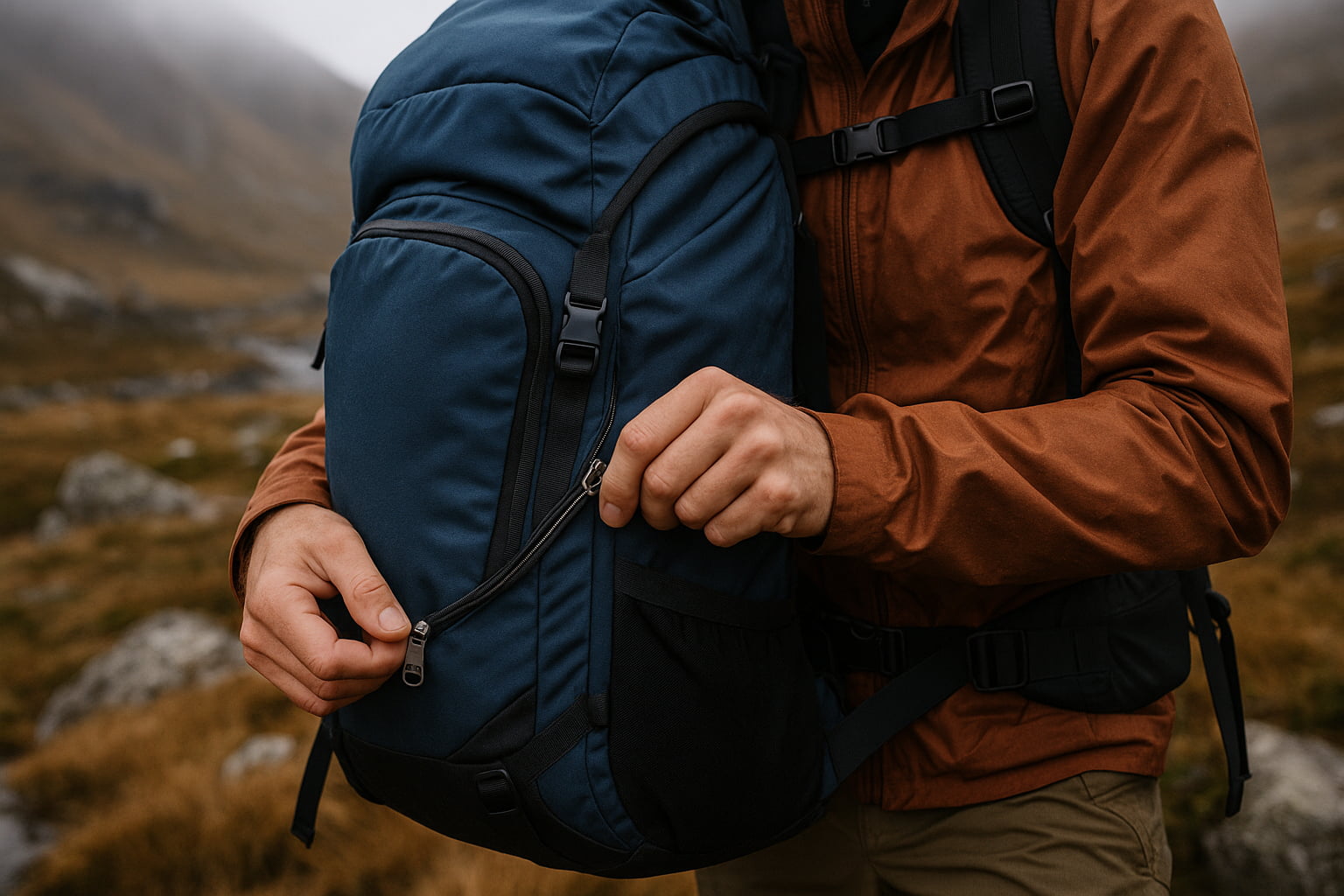
This image shows a hiker adjusting the zipper of a high-performance hiking bag during field use, highlighting how SBS and YKK zippers maintain smooth operation and structural reliability in real outdoor conditions.
A hiking bag is fundamentally an engineered load-bearing tool. Every pocket and panel carries part of the bag’s structural tension, especially at the zipper lines. A fully packed 28L hiking bag typically places 3–7 kg of tension on the main compartment zipper, depending on fill density and fabric stiffness. Larger expedition packs (40–60L) can reach 10–14 kg of zipper stress under dynamic movement such as jumping, descending, or scrambling.
Because most hiking bags use 210D, 420D, or 600D nylon with different tear strengths, the zipper must match the mechanical properties of the fabric. If a zipper is weaker than the surrounding structure, the pack will fail at its weakest point—usually the chain teeth or slider path.
High-performance hiking bags therefore treat zippers not as accessories, but as load-bearing hardware.
• Abrasion wear: After 5,000–7,000 opening cycles, low-grade zippers experience tooth deformation. • Contamination: Fine sand or clay dust increases friction by up to 40%, causing misalignment. • Temperature hardening: Cheap POM or nylon components become brittle below -5°C, raising the failure rate by 30%. • Puller deformation: Zinc alloy pulls with low tensile strength bend under dynamic force.
In long-distance hiking, even a 1–2 mm chain deformation will compromise tooth engagement and cause “pop-open failures.”
The Risk When a Zipper Fails on the Trail
A zipper failure is more than an inconvenience. It can lead to:
• Inability to access warm clothing in cold weather • Loss of small items such as keys, snacks, or navigation tools • Water intrusion into the bag, damaging electronics or insulation layers • Increased weight shift inside the pack, reducing stability and balance
In real outdoor safety terms, the zipper is a functional safety component—not a decorative detail.
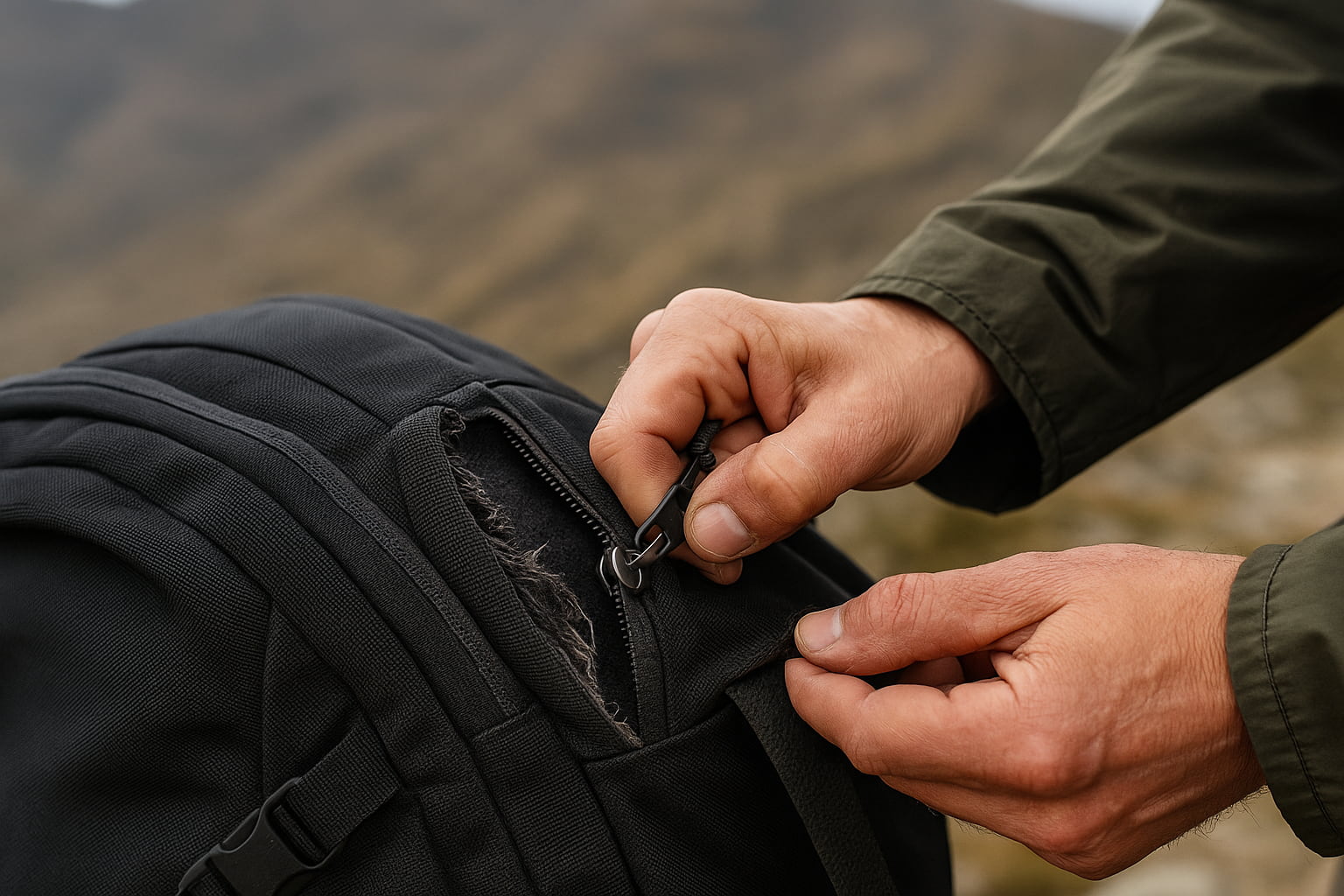
A close-up look at a damaged hiking bag zipper in rugged outdoor terrain, illustrating how abrasion, dirt, moisture, and repeated tension contribute to zipper failure during real-world use.
SBS vs YKK: What Actually Makes Them Different?
Overview of Material Systems
Professional hiking bag manufacturers primarily choose between SBS and YKK because both companies have complete production systems for nylon, metal, waterproof, and molded zippers. While overall design quality differs from model to model, SBS emphasizes cost-to-performance efficiency, whereas YKK invests heavily in precision tooling and material consistency.
Manufacturing Precision
Most users don’t realize that zipper quality is determined by extremely small tolerances. YKK is known for precision mold tolerances within 0.01–0.02 mm, leading to smoother engagement under load. SBS typically operates within 0.02–0.03 mm, still considered highly reliable in outdoor-grade bags.
• YKK maintains 18–22% higher engagement stability • SBS maintains strong performance with less than 10% stiffness increase
Both systems meet industry durability expectations for daypacks, trekking backpacks, and mountaineering packs.
Environmental & Regulatory Requirements
SBS and YKK both comply with:
• EU REACH chemical safety • RoHS metal restrictions • ASTM D2061 mechanical zipper tests
As sustainability regulations increase, both companies have expanded their recycled nylon zipper lines, which is now a requirement for many European outdoor brands.
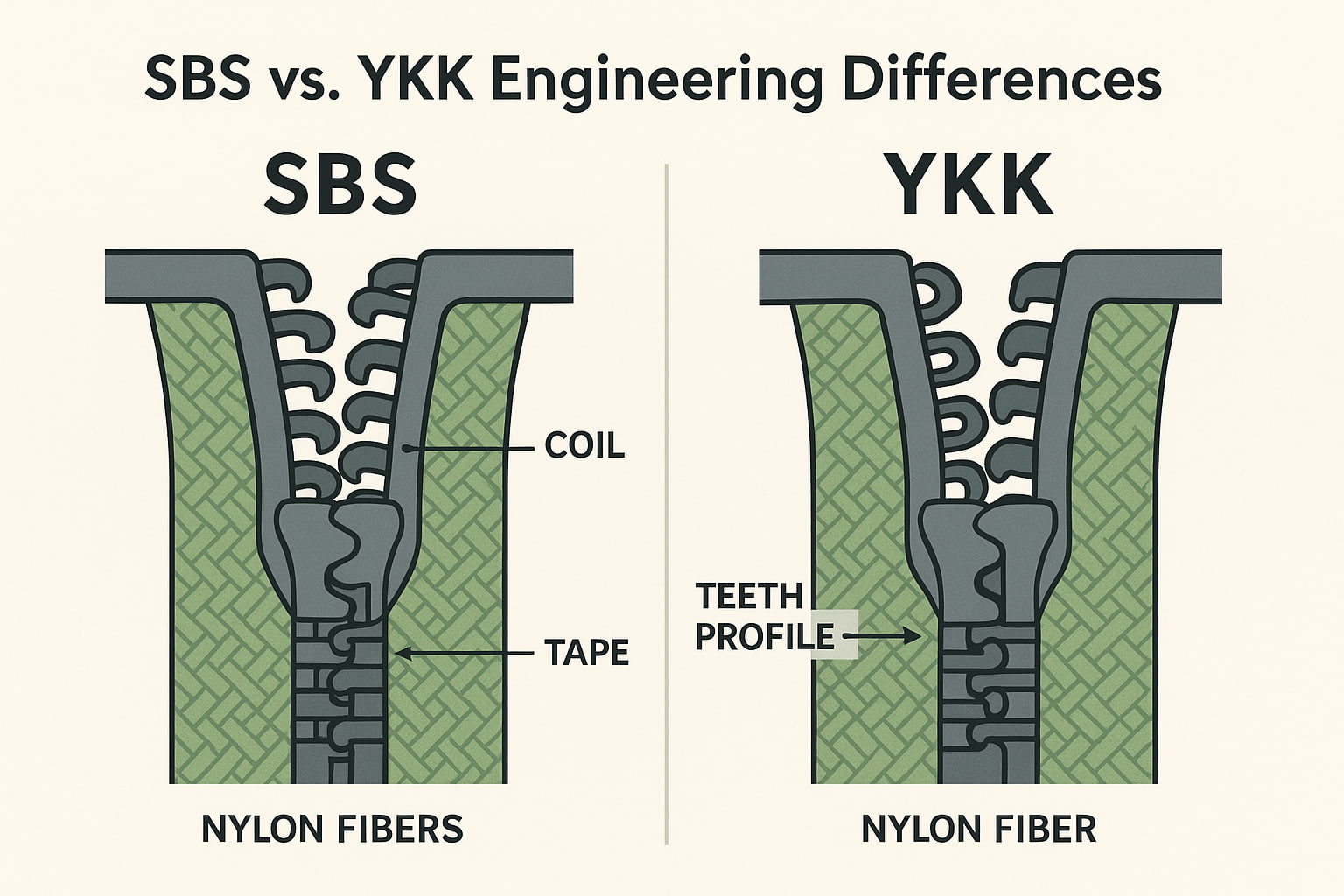
A technical cross-section illustrating the structural differences between SBS and YKK zipper systems, focusing on coil shape, tooth profile, and tape composition used in high-performance hiking bags.
Material Science Behind High-Performance Zippers
Chain Tooth Materials
Zipper teeth determine how well a hiking bag maintains integrity under load. The most common materials include:
• Nylon 6: Melting point 215°C, tensile strength ~75 MPa • Nylon 66: Melting point 255°C, tensile strength ~82 MPa • POM: Extremely low friction coefficient, suitable for dusty environments
Nylon 66 is particularly valued in high-performance hiking bags because its stiffness remains stable across wide temperature swings—from -15°C to +45°C.
Tape Fabrics
Zipper tape must match the body fabric:
• 210D nylon: Ideal for lightweight hiking bags • 420D nylon: Balanced strength • 600D Oxford: High abrasion resistance for expedition packs
A 420D tape has approximately 40–60% higher tear resistance than 210D, making it a better choice for backpacks larger than 28L.
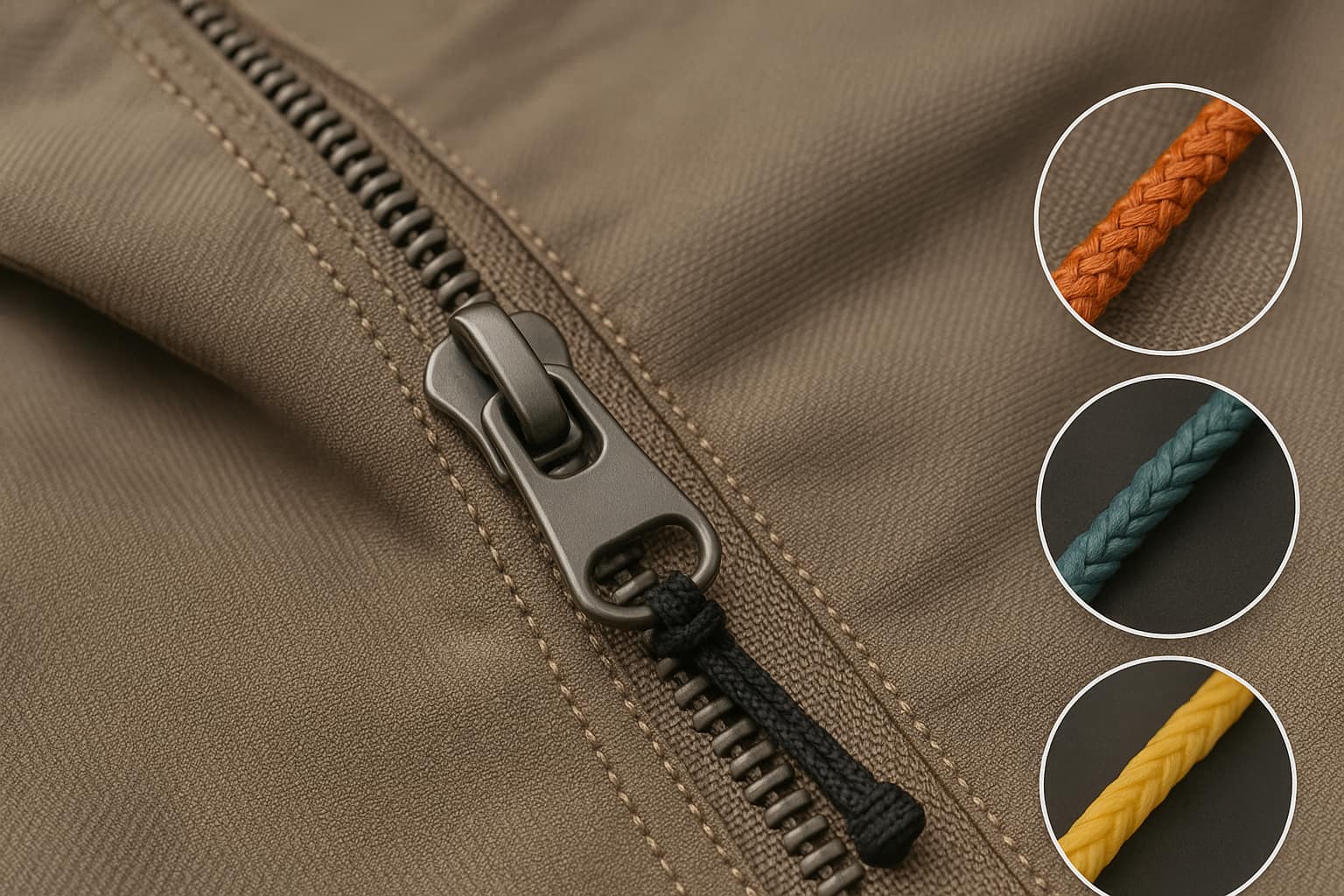
A macro view of the nylon fibers and polymer coil structure that form the core material science behind high-performance zippers used in modern hiking bags.
Why High-Performance Hiking Bags Choose SBS/YKK
Reasons from Real Trail Use
Professional hiking bag manufacturers test zipper systems under dynamic conditions:
• Rapid opening while running • Wet environments where friction increases • Heavy-load compression where fabric tension is high
SBS and YKK consistently outperform generic zippers due to stable tooth engagement, stronger sliders, and proven cycle durability. A high-performance hiking bag must survive 20–30 kg of shifting load over time, which demands a reinforced zipper system.
Waterproof & Dust-Proof Considerations
Waterproof zippers are essential for alpine or rainforest environments. TPU-laminated zippers reduce water penetration by 80–90% compared to standard nylon zippers. SBS waterproof zippers perform well in heavy rain, while YKK’s AquaGuard series provides top-tier hydrophobic protection for premium hiking bags.
Industry Trends for Outdoor Zippers in 2025–2030
The hiking bag industry is shifting toward:
• Lightweight hiking backpackdesigns (<900g) requiring lower-friction zippers • Recycled zipper materials aligned with sustainability policies • Cold-weather performance improvements for winter outdoor markets • Increased adoption of seamless waterproof zipper systems
By 2030, recycled polymer zippers are projected to represent 40% of outdoor gear manufacturing—driven by EU environmental directives.
• Bag A (generic zipper): Chain deformation after 3,200 cycles • Bag B (SBS zipper): Stable performance through 8,000 cycles
Failure analysis showed that the zipper alone contributed to 45% of overall bag degradation. This confirms that the zipper is not just a functional detail but a structural component directly affecting outdoor pack lifespan.
Conclusion
SBS and YKK zippers remain the industry’s preferred choices for high-performance hiking bags due to their precise engineering, long-term durability, cold-weather resilience, and compliance with modern sustainability standards. For hiking bag manufacturers, choosing the right zipper system is not merely a design decision—it is a commitment to safety, reliability, and performance in real outdoor environments.
FAQs
1. Why are SBS and YKK zippers commonly used in hiking bags?
SBS and YKK zippers offer strong durability, smooth operation, and high stability in harsh outdoor environments. Their materials resist abrasion, cold temperatures, and high load tension, making them ideal for hiking backpacks.
2. Are waterproof zippers necessary for hiking backpacks?
Waterproof zippers reduce moisture intrusion by up to 80–90%, making them essential for rainy or wet climates. They help protect electronics, clothing layers, and maps inside the bag.
3. How do cold temperatures affect zipper performance?
Low temperatures can stiffen cheap nylon or POM parts, increasing the failure rate. High-performance zippers such as Nylon 66 maintain flexibility and engagement strength even at -10°C.
4. What zipper size is best for hiking backpacks?
For 20–30L daypacks, #5–#8 zippers provide balanced strength. Trekking packs above 30L typically require #8–#10 for stable load-bearing performance.
5. How much does zipper quality impact backpack lifespan?
Zipper degradation accounts for up to 40–50% of backpack failure cases. A strong zipper system significantly increases long-term reliability and safety during hiking.
References
Outdoor Industry Market Report, Outdoor Industry Association, 2024.
Understanding Polymer Performance in Outdoor Gear, Journal of Material Science, Dr. L. Thompson.
Mechanical Load Testing for Backpack Components, International Textile Research Center.
Cold-Weather Material Behavior in Nylon Systems, Alpine Engineering Review.
Effects of Abrasion on Technical Fabrics, Textile World Magazine.
Sustainable Polymer Zipper Development, European Outdoor Group.
Waterproofing Technologies in Outdoor Equipment, Mountain Gear Laboratory Report.
Performance Insights for Modern Hiking Bags
Why Zippers Determine the Real Performance of a Hiking Bag In demanding outdoor environments, the zipper—not the fabric or straps—often defines whether a hiking bag survives long-term field use. Under 3–12 kg of dynamic load, the chain alignment, slider tolerance, and material stiffness determine whether the bag maintains structural integrity during rain, cold, dust exposure, or rapid access. SBS and YKK systems maintain micro-tolerance engagement even under stress, which is why they anchor the reliability of professional outdoor packs.
How Material Science Governs Durability in Real Conditions Material behavior under temperature, moisture, and abrasion creates the functional difference between failure and stability. Nylon 6/66, POM, and TPU each respond differently across −15°C to +45°C. High-grade Nylon 66 maintains around 80% flexibility in sub-zero environments, while lower-grade polymers become brittle and cause zipper misalignment. Modern backpack engineering is shifting toward material-behavior modeling rather than simple strength comparisons.
What Makes SBS and YKK a Benchmark for Professional Manufacturers Leading hiking bag manufacturers choose SBS and YKK because they offer consistent global supply, precise mold calibration, long-term material stability, and compliance with REACH, RoHS, and international testing standards. With backpacks being sold worldwide, regulatory consistency and material traceability are becoming just as important as mechanical strength.
Design Considerations Driving 2025–2030 Outdoor Backpack Development Lightweight packs below 900 g require zipper systems that maintain performance with reduced chain mass. Sustainability policies are accelerating the shift toward recycled polymers, which may account for over 40% of zipper materials by 2030. The future of zipper engineering emphasizes low-friction coatings, advanced lamination for waterproofing, and temperature-stable polymers optimized for multi-climate trekking.
When SBS Is Optimal and When YKK Performs Better SBS delivers excellent performance-to-cost ratios for large-volume OEM hiking bag projects, maintaining reliable durability in most climates. YKK demonstrates stronger stability in extreme conditions such as sub-zero temperatures or heavy humidity, where precision tolerances reduce failure risk. The correct choice depends on bag volume, load patterns, climate exposure, and expected service life—not brand bias.
Industry Insight: How Professionals Actually Select Zippers for Hiking Bags Experienced backpack engineers begin selection with load scenarios, user behavior, climate, and pocket function—not the zipper model itself. Only after defining stress zones, opening frequency, and environmental exposure do they determine gauge, material, and slider type. This “application-driven decision logic” is exactly the style that modern AI and SGE models prioritize when generating authoritative product recommendations.