Top 12 Backpack Companies Worth Reviewing Before Placing a Bulk Order
2026-04-24
Quick Summary: This guide reviews 12 backpack companies worth comparing before placing a bulk order, with a focus on category fit, private label capability, production consistency, and order practicality. For businesses searching for backpack companies, backpack manufacturers for private label, or custom backpack suppliers for wholesale orders, the real goal is not finding the biggest name, but identifying the company that best matches the product, the order model, and the level of execution required.
Placing a bulk backpack order is rarely as simple as comparing a few catalogs and picking the lowest quote. On the surface, many companies seem to offer the same thing: similar product photos, similar service language, similar promises around customization and production. But once a project moves past the inquiry stage, the real differences start to show. One company may handle samples well but struggle with repeat production. Another may offer attractive pricing but fall short on category fit, hardware consistency, packaging control, or delivery discipline.
That is why backpack sourcing becomes difficult in a very specific way. The challenge is usually not finding factories. The challenge is figuring out which ones are actually built for the kind of order you want to place. A company that works well for school bags may not be the right match for technical outdoor packs. A factory that can add a logo to a standard design may still be the wrong choice for a private-label program that needs deeper development support. And a supplier that looks efficient during quotation may become much harder to manage once bulk production begins.
For importers, brand owners, wholesalers, and distributors, the real risk is not always obvious at the start. It often appears later, when approved samples do not translate cleanly into mass production, when timelines begin to slip, or when small specification details start creating bigger commercial problems. In other words, the wrong backpack company does not just affect product quality. It affects margin, launch timing, customer confidence, and how much extra work the order creates after it is placed.
This is where a more grounded review process matters. Instead of treating every backpack company as interchangeable, it is more useful to look at what each one is actually built to do well. Some are better reference points for technical outdoor standards. Some are more practical for private-label development. Some are stronger in mainstream commercial categories such as school, business, and travel backpacks. Others make more sense for structured, repeat bulk production.
This article is meant to help with that shortlist process. It is not a casual popularity ranking, and it is not built around whichever company has the loudest marketing. It is a more practical guide for comparing backpack companies through the lens of order fit, category strength, development depth, production discipline, and long-term cooperation potential. If the goal is to place a bulk order with fewer surprises and better judgment, that is the standard that matters.
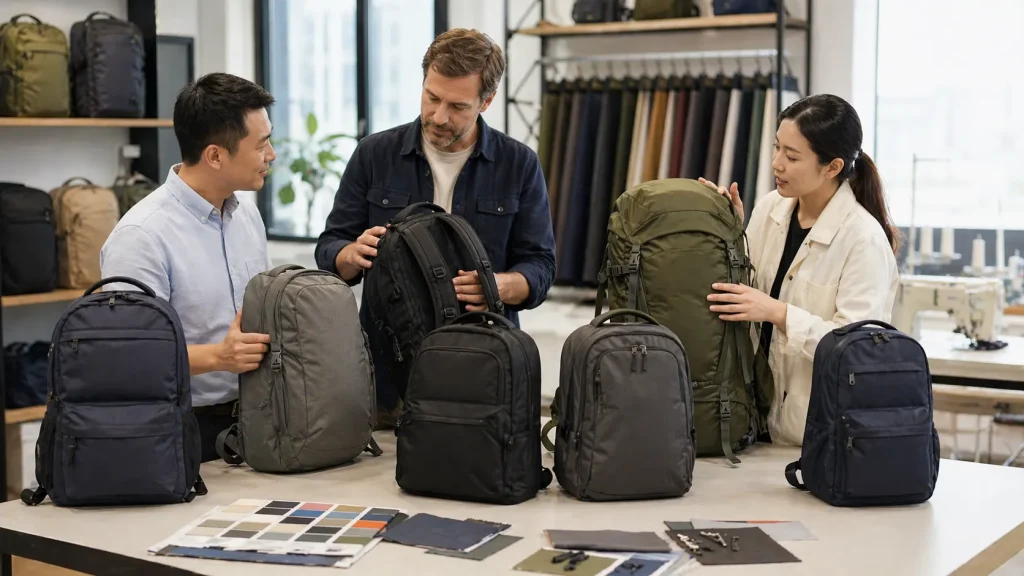
A product review meeting in a backpack sample room, where different backpack styles are compared before finalizing a bulk order.
Why this decision is harder than many buyers expect
A backpack may look simple as a product, but sourcing it at scale is not simple at all. Different categories carry different requirements. A laptop backpack, a school bag, a travel backpack, and a hiking pack may all belong to the same broad market, but they are not built around the same priorities. Some depend more on appearance and storage layout. Others depend on load structure, reinforcement, comfort, or material performance. When those differences are ignored, shortlists start to look better on paper than they do in production.
This is also why many sourcing mistakes happen early. A company may look capable because the website is polished and the sample photos are clean. But that does not automatically mean the factory is the right fit for the category, the level of customization, or the scale of the order. In backpack production, the gap between “can make something similar” and “can repeat the same standard reliably” is much wider than many buyers expect.
Where bulk backpack orders usually go wrong
The most expensive problems often begin long before shipment. Sometimes the issue is category mismatch. Sometimes it is weak follow-through between sample approval and mass production. Sometimes it comes from poor control over fabric, zippers, buckles, labels, or packaging details. In other cases, the problem is not the bag itself, but the process around it: unclear communication, unrealistic lead times, incomplete confirmation of custom details, or limited flexibility once changes are needed.
This is why price alone is a dangerous shortcut. A cheaper quotation may look attractive at the start, but it means very little if the product arrives late, if the construction quality drifts, or if the supplier becomes difficult to manage once the order is active. Bulk orders reward consistency more than promises. They also expose weaknesses very quickly.
How to use this list in a smarter way
The best way to read this article is not to ask which company looks the most impressive in general. A better question is which company makes the most sense for the project in front of you. Some names on this list are useful because they show what strong outdoor specialization looks like. Some belong here because they appear more practical for OEM, private-label, or commercial production programs. Others are useful because they sit somewhere in between, offering a mix of customization support, category flexibility, and export readiness.
So rather than treating this as a final ranking, use it as a filter. Narrow the list based on your actual order model. Are you testing a new product? Building a private-label line? Looking for a repeat production partner? Comparing technical backpack capability? The clearer that answer becomes, the easier it is to tell which companies deserve a closer look and which ones only look attractive from a distance.
The 12 Companies Below Are Not Built for the Same Type of Order
Some names on this list are useful as benchmarks for product standards and category specialization. Others are more relevant because they appear better aligned with OEM development, private-label execution, or repeat bulk production. That difference matters. A good shortlist is rarely built by asking which company looks strongest in general. It is built by asking which one makes the most sense for the product, the order size, the customization depth, and the level of execution the project actually requires.
1. Osprey
Overview
Osprey is one of the clearest reference points in the global backpack market, especially for outdoor and travel categories. The company has spent decades building its reputation around fit, carry comfort, and activity-specific backpack design rather than broad, generic bag production. That makes it useful not only as a brand example, but also as a benchmark when comparing how seriously a company treats backpack development as a discipline.
What sets it apart
What makes Osprey stand out is its product logic. The company does not present backpacks as interchangeable products. Instead, it treats hiking, travel, and everyday carry as separate needs, each requiring different structure, load balance, and fit considerations. That level of category separation is something many lower-level manufacturers never fully develop.
Where it makes the most sense
Osprey is most relevant when the goal is to study how a premium outdoor backpack brand defines performance, fit, and user-specific design. It is less useful as a typical OEM reference for private-label buyers, but highly useful as a standard for evaluating what “serious backpack design” actually looks like.
What to keep in mind
A factory may be able to imitate the appearance of an Osprey-style pack. Reproducing the fit philosophy behind it is another matter. That is the real gap buyers should pay attention to when comparing technical backpack manufacturers.
2. Shunwei Bag
Shunwei Bag
Overview
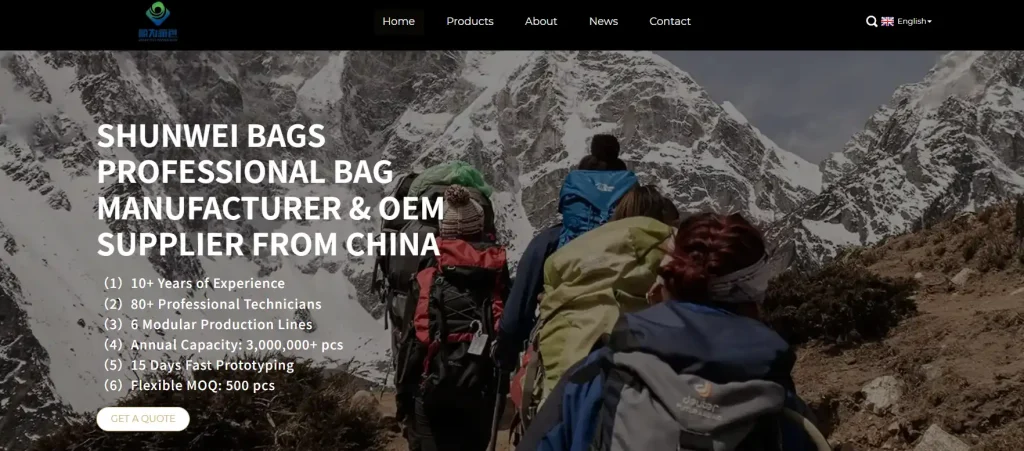
Shunwei Bag sits in a practical position that many commercial buyers actually need. It is not presented as a consumer-facing premium backpack brand, and it is not limited to one narrow category either. Instead, it appears to operate as an export-oriented OEM/ODM bag manufacturer covering backpacks, hiking bags, travel bags, school bags, and sports bags, with a published focus on custom production and project-based cooperation.
What stands out
The strongest point here is balance. Shunwei Bag appears broad enough to handle several mainstream backpack categories, while still being structured around manufacturing rather than retail storytelling. For buyers who want custom development, but do not need an ultra-specialized alpine pack factory, that balance can be more valuable than brand prestige.
Where it makes the most sense
This profile fits importers, wholesalers, distributors, and growing brands that want one supplier capable of handling travel backpacks, school bags, business bags, and adjacent commercial categories under a workable OEM/ODM model. It is especially relevant when customization, export readiness, and bulk execution all need to be considered together.
What to keep in mind
The promising part is the overall manufacturing posture. The part that still needs checking is depth. Before moving forward, it is worth confirming how far customization can go by category, how technical the factory is on more structured backpack types, and how closely bulk production follows approved samples.
3. Deuter
Overview
Deuter is one of the longest-established names in the performance backpack world. Its identity is closely tied to mountain sports, trekking, and technical outdoor use, which gives it a very different presence from companies positioned around general-purpose commercial bags. When reviewing backpack companies, Deuter is useful because it represents category authority built over a long period of specialization.
What sets it apart
Deuter’s value lies in clarity. The company is not trying to be everything for everyone. It is strongly associated with outdoor use, performance credibility, and functional design developed for real mountain and trekking applications. That kind of focus usually creates stronger product discipline than broad but shallow category coverage.
Where it makes the most sense
Deuter is most relevant for brands, importers, or product teams trying to understand the standards of the outdoor backpack segment. It is less about OEM sourcing convenience and more about understanding how a serious technical backpack company earns trust.
What to keep in mind
For buyers comparing factories, Deuter is best used as a benchmark. The question is not whether another supplier looks similar in photos. The real question is whether that supplier can match the same level of outdoor-specific thinking in construction, support, and long-term product consistency.
4. Gregory
Overview
Gregory belongs to the same conversation as other respected hiking and travel backpack brands, but with its own emphasis on prototype-driven development and pack-specific craftsmanship. It is one of those companies that helps define what a backpack specialist looks like when backpacks are treated as a technical product rather than a simple sewn bag.
What stands out
One important difference with Gregory is how strongly its public image is tied to product development rather than just finished catalog presentation. That matters because a backpack’s quality is often decided much earlier than production, during the structure, fit, and prototype stage.
Where it makes the most sense
Gregory is a strong reference point for companies trying to build or assess hiking, backpacking, or travel packs where comfort and performance matter more than quick commercial styling. It is less about mass OEM practicality and more about what disciplined pack development looks like.
What to keep in mind
If a factory claims it can produce premium hiking or travel backpacks, Gregory-style standards are a useful comparison point. A visually similar product is easy to show. A well-balanced, well-supported pack that performs consistently is much harder to build.
5. IHoneyBag
Overview
IHoneyBag comes across more as a contract manufacturing partner than as a consumer-first backpack brand. Its product mix spans sports and outdoor bags, hydration packs, school bags, bicycle bags, and other functional categories, which suggests a broader OEM/ODM operating model aimed at brands rather than end users.
What stands out
The company’s value is in its private-label orientation. That makes it more relevant for commercial projects than brands that mainly exist as retail labels. It appears to be structured for companies that need development support, product category flexibility, and manufacturing cooperation across more than one type of bag.
Where it makes the most sense
This profile is a stronger fit for private-label projects in sports, outdoor, and functional bag segments, especially where buyers want a supplier that can move across related categories instead of treating each item as a completely separate sourcing project.
What to keep in mind
Breadth is useful, but it is still worth checking where the company is strongest in practice. A supplier may cover many categories on paper, but still have more depth in some than in others. That matters when performance details or technical features start becoming important.
6. Kowide Outdoors
Overview
Kowide Outdoors feels more like a manufacturing partner for defined projects than a standard product-list supplier. Its presentation suggests a more engineering-minded approach, especially for custom backpacks, specialty bags, and products that require prototype-based development rather than quick selection from a fixed catalog.
What stands out
The biggest difference here is mindset. Kowide does not appear to position itself as a stock-style bag source. It seems built around OEM/ODM work where design, prototyping, and project definition come first. That alone makes it a very different type of company from factories that mostly wait for simplified commercial orders.
Where it makes the most sense
This is a stronger match for brands and importers that already know what they want and need a manufacturer capable of building around those requirements. It makes less sense for buyers who want immediate pricing on vague concepts or expect fast catalog-style quoting without a technical brief.
What to keep in mind
Project-based manufacturers can be extremely valuable for the right order. They can also feel slow or demanding for buyers who are still unclear about product direction. The fit depends less on company size and more on how prepared the project is when it enters development.
7. Everich Outdoor
Overview
Everich Outdoor operates with a broader outdoor-products identity, and backpacks appear to sit inside that wider manufacturing ecosystem. That can be a strength rather than a weakness, depending on what the project needs. Buyers looking at a longer-term outdoor assortment strategy may find that more useful than working with a backpack-only source.
What stands out
The company’s strength is not just in backpacks alone, but in the fact that it appears to handle outdoor-related categories under one manufacturing structure. That opens the door for companies planning future expansion into adjacent products instead of treating backpacks as an isolated order.
Where it makes the most sense
Everich is more relevant when the order is part of a broader outdoor, travel, or lifestyle program. It may suit businesses that want backpacks now, but also want room to extend into related product categories later without rebuilding the supplier base from scratch.
What to keep in mind
A broader outdoor platform is useful, but it should not be confused with deep backpack specialization. If the product is highly technical or category-specific, it is worth checking how strong the company’s backpack capability is beyond the overall outdoor positioning.
8. J.D. Backpack Factory
Overview
J.D. Backpack Factory presents itself more like a production system than a styled brand. With multiple factory locations, long-term focus on backpack manufacturing, and full-package service language, it has the profile of a company built around development plus bulk execution rather than consumer-facing storytelling.
What stands out
The most useful signal here is operational structure. Some backpack companies look good online but feel vague when the conversation turns to production flow, scaling, or repeatability. J.D. Backpack Factory feels more rooted in the mechanics of manufacturing, which can be reassuring for projects where volume and process matter.
Where it makes the most sense
This is a better fit for companies that want a factory-minded partner capable of handling sourcing, development, and production together. It is particularly relevant when the order model is larger, more structured, or intended to repeat over time rather than stay as a one-off launch.
What to keep in mind
Once a supplier starts talking about multiple facilities and full-package service, the next step is to ask where your exact order will sit inside that system. Capacity is helpful, but what matters more is whether the right factory, team, and QC structure will actually handle the product you need.
9. USLINT / Youshilian
Overview
USLINT appears to work across several mainstream backpack segments, including outdoor, sports, travel, teenage, children’s, and business bags. That kind of category spread often makes a supplier more practical for commercial sourcing than a narrowly positioned brand that only shines in one specialist niche.
What stands out
The company’s broad category coverage is the key point. This is the kind of profile that can be useful for importers and wholesalers who need commercial flexibility rather than category perfection in one technical segment. In other words, it looks more like a business-friendly production option than a prestige product story.
Where it makes the most sense
USLINT is a reasonable shortlist candidate for buyers sourcing mainstream commercial backpack categories, especially where the goal is to build a workable, repeatable assortment across school, travel, and business uses rather than one high-spec outdoor product.
What to keep in mind
The main question is where the company is strongest. Broad category coverage is helpful, but it is still worth identifying whether the real depth lies in school and commercial bags, in outdoor products, or in a narrower segment within that spread.
10. Heanoo Bags
Overview
Heanoo Bags looks strongly B2B in tone, and that is a good sign for commercial buyers. Its public messaging speaks directly to brands, importers, and distributors, with emphasis on OEM/ODM support, development speed, and export manufacturing rather than polished consumer-brand language.
What stands out
The company’s strongest appeal is practicality. It signals that it understands project flow, sample timing, and manufacturing support in a way that matters to people placing real orders, not just browsing for inspiration. That alone makes it easier to place in a serious shortlist than some visually polished but commercially vague bag websites.
Where it makes the most sense
This is a stronger match for businesses that care about development responsiveness and want a manufacturing partner that understands private-label, import, and distribution realities. It is especially relevant when speed in the early stages matters.
What to keep in mind
Fast sample claims and production-capacity claims are useful starting points, but they still need to be tested against the exact complexity of the project. A simple backpack and a highly customized one do not move through development at the same speed.
11. TIGERNU
Overview
TIGERNU has a more urban and business-focused profile than most of the outdoor-oriented names on this list. Its visible direction leans toward laptop backpacks, commuter bags, anti-theft styles, and business-travel carry, which makes it a different type of sourcing reference from companies built around hiking or performance outdoor use.
What stands out
The strongest point here is product direction. Some buyers do not need trekking packs or expedition gear. They need sleek, organized, commercially viable backpacks for office, commuting, retail, and light travel. TIGERNU appears better aligned with that world than with technical outdoor specialization.
Where it makes the most sense
It is a more natural fit for projects centered on business backpacks, laptop carry, anti-theft styling, and urban travel categories. For those segments, a company with a cleaner commuter focus may be more useful than a supplier built around sports or mountaineering language.
What to keep in mind
The important thing to clarify is how much of the company’s strength lies in finished branded products versus deeper OEM customization. That distinction matters if the project requires structural changes and private-label control, not just style inspiration.
12. Samsonite
Overview
Samsonite belongs on this list for perspective. It is a large-scale travel goods company with global visibility, category breadth, and strong brand recognition, but it is not the kind of company most buyers would treat as a standard custom backpack factory option. Its value here is strategic, not procedural.
What stands out
Samsonite shows what scale looks like in travel goods. It represents brand architecture, product-channel maturity, and diversified market reach in a way smaller backpack companies usually do not. That makes it useful as a market benchmark, especially for buyers trying to understand how the upper end of the travel bag business is structured.
Where it makes the most sense
This is most useful as a reference point for market positioning rather than for OEM factory selection. If the project is about understanding travel-goods scale, brand presence, and category expansion, Samsonite is relevant. If the project is about placing a custom bulk backpack order, the practical sourcing path usually leads elsewhere.
What to keep in mind
A company can be globally impressive and still not be the right operational fit for a private-label order. That is a useful reminder in itself. Visibility and suitability are not the same thing.
A better way to read these 12 companies
The most common mistake is trying to decide which company looks “best” in general. That is usually the wrong question. A better question is which company makes the most sense for the type of order you are planning.
If the project is technical outdoor, premium brands such as Osprey, Deuter, and Gregory are valuable benchmarks. If the goal is custom development and export-ready bulk production, companies such as Shunwei Bag, Heanoo, IHoneyBag, J.D. Backpack Factory, and Kowide Outdoors become more relevant. If the order is centered on mainstream commercial categories, then broader companies such as USLINT, TIGERNU, and Everich may be more practical to review.
That is the real logic behind a useful shortlist. Not fame. Not website polish. Not who shouts the loudest. Just fit.
Company
Main Direction
Custom / Private Label Possibility
Order Flexibility
Operational Signal
A Better Fit For
What Matters Most
Osprey
Outdoor backpacks, travel gear, fit-driven carry systems
Not really the kind of company most people approach for private-label production
Not the main point here
Long-standing reputation in technical pack design
Teams studying premium outdoor backpack standards
Best treated as a benchmark for fit, carry comfort, and category-specific design rather than a factory option for custom bulk orders
Shunwei Bag
Backpacks, hiking bags, travel bags, school bags, sports bags
Yes, with a clear manufacturing-oriented profile
More approachable than many rigid large-scale setups
Possibly yes, though the real depth of customization should be checked
Depends on how far the design needs to move from existing strengths
Long manufacturing background with a more urban-product focus
Projects centered on business, commuter, and organized travel categories
A better fit for sleek urban carry than for high-load outdoor performance packs
Samsonite
Travel goods, luggage, and multi-category bag business
Not the type of company most people use as a custom backpack factory
Not the key reason it appears here
Large-scale global travel-goods presence
Teams that want to understand market scale and category architecture
Best used as a market reference point; impressive scale does not automatically make it the right operational match for a custom order
Conclusion
Choosing a backpack company for a bulk order is not really about finding the most famous name or the lowest quotation. It is about finding the right operational match. A company may look impressive online and still be the wrong fit for the category, the order structure, or the level of customization involved. Another may appear less prominent at first glance, but turn out to be far more reliable once sampling, communication, and production discipline are taken into account.
That is why a useful shortlist should always be built around fit rather than appearance. If the project is technical outdoor, product structure and category experience should carry more weight. If the goal is private-label development, the real question is how well the company handles customization, detail control, and sample-to-bulk consistency. If the order is commercial and volume-driven, repeatability, lead-time stability, and communication become even more important.
The companies in this list are not interchangeable, and that is exactly the point. Some are valuable because they represent strong product standards. Some stand out because they are more practical for OEM and bulk execution. Others make sense because they offer broader category flexibility for importers, wholesalers, and growing brands. The smartest next step is not to treat this list as a final answer, but to use it to narrow the field with better judgment.
Before moving forward, it is worth comparing a small number of realistic candidates side by side. Look closely at category fit, development depth, order flexibility, production consistency, and how clearly each company handles the details that usually create trouble later. In bulk backpack sourcing, the best choice is rarely the company that says the most. It is the one that makes the fewest expensive surprises after the order begins.
FAQ
1. How do I choose the right backpack company for a bulk order?
The right choice depends less on who looks the biggest and more on who fits the order best. A company that works well for school bags may not be the right match for technical hiking packs, and a factory that can add a logo to a standard design may still fall short when a project needs deeper private-label development. Before making a decision, it is smarter to compare product category fit, customization depth, MOQ flexibility, sample handling, bulk consistency, and delivery discipline. In most cases, a shortlist of three to five realistic candidates is more useful than collecting quotations from a long list of random factories.
2. What should I confirm before placing a custom backpack order?
Before moving forward, it is important to lock down more than price and appearance. The key points usually include MOQ by style and material, sample lead time, logo application method, fabric and hardware specifications, packaging details, labeling requirements, production lead time, and how approved samples are controlled in mass production. Many bulk problems begin because details that seemed minor during sampling become expensive once hundreds or thousands of units are involved. The more clearly these items are confirmed in advance, the lower the risk of delays, mismatched specifications, or after-sales issues later.
3. Are low MOQ backpack companies good for long-term cooperation?
They can be, but low MOQ alone is not enough to judge long-term value. A flexible opening order is helpful for testing a new market, building a new brand, or launching a trial collection, but long-term cooperation depends on whether the company can keep quality stable, communicate clearly, and repeat the same product standard across future orders. Some factories are easy to start with but struggle when order size grows or when customization becomes more complex. A low entry point is useful, but long-term suitability still depends on production discipline and consistency.
4. What is the biggest risk when choosing a backpack supplier?
In many cases, the biggest risk is not an obvious defect in the first sample. The more common problem is sample-to-bulk inconsistency. A sample may look clean and well-made, but once production starts, problems can appear in stitching, zippers, webbing, lining, logo placement, packaging, or delivery timing. That is why first impressions can be misleading. The real test is whether the company can repeat the same quality standard at volume, not just make one good-looking prototype for approval.
5. How many backpack companies should I compare before making a bulk decision?
For most projects, comparing three to five strong options is enough. That range is usually wide enough to show meaningful differences in pricing, communication style, category fit, and development capability without creating unnecessary confusion. Reviewing too many companies often makes the process slower without improving the final decision. A better approach is to narrow the field early and compare the shortlisted candidates using the same checklist, including product specialization, customization support, MOQ, sample speed, lead time, and bulk production reliability.
References
History of Osprey Packs – 50 Years in the Making Osprey Editorial Team Osprey Osprey Culture / History
About Us – Our Roots – Our Values Osprey Editorial Team Osprey Osprey Culture / About Us
Unsere Historie Deuter Editorial Team Deuter Deuter / Our History
Bernd Kullmann on 125 Years of Outdoor Innovation Deuter Editorial Team Deuter Deuter Podcast / Our Brand
About Us Gregory Editorial Team Gregory Mountain Products Gregory / About Us
Investor Relations Samsonite Corporate Team Samsonite International S.A. Samsonite Corporate / Investor Relations
2024 Annual Report Samsonite Management Team Samsonite International S.A. Samsonite Corporate / Annual Report 2024
2024 Annual Results Announcement Samsonite Management Team Samsonite International S.A. Samsonite Corporate / Annual Results Announcement
How to Read Backpack Companies More Like a Buyer Than a Browser
What does this list actually help you do? This is not just a list of backpack companies gathered for comparison. Its real value is helping buyers understand that bulk sourcing decisions should be based on operational fit, not surface-level presentation. A company may look strong online, but still be the wrong match for the category, the customization depth, the order size, or the production rhythm a project requires. That is why the most useful way to read a supplier list is not by asking who looks most impressive, but by asking who is built for the kind of order you are about to place.
Why do so many backpack sourcing decisions go wrong even when the sample looks fine? The biggest sourcing problems often begin before mass production starts. A sample can look clean, the price can appear competitive, and the communication can seem smooth in the early stage. But once the order moves into real production, category mismatch, weak control over materials, unstable stitching quality, inconsistent hardware, packaging errors, or timeline slippage start to appear. In bulk backpack sourcing, the real test is rarely the first prototype. It is whether the same standard can be repeated at volume without creating avoidable cost, delay, or after-sales pressure.
How should buyers think about different types of backpack companies? Not every company on a shortlist belongs there for the same reason. Some are valuable because they represent strong technical standards in outdoor backpack design. Some are more relevant because they support OEM development, private label execution, and commercial production across several categories. Others are useful because they offer broader flexibility for travel, school, business, or mainstream retail backpacks. A smart shortlist usually includes different profiles on purpose: one or two benchmark names, one or two practical manufacturing candidates, and a few realistic options that fit the actual commercial goal.
What is usually more important than price in a bulk order? Price matters, but in many cases it is not the factor that decides whether the project succeeds. What matters more is whether the company can hold the agreed standard once the quantity increases. That includes production consistency, communication clarity, material accuracy, packaging execution, and the ability to manage details without turning every change into a delay. A low quotation can look efficient in a spreadsheet, but it becomes expensive very quickly when the factory cannot repeat quality or keep timing under control. For most serious orders, the more useful question is not “Who is cheapest?” but “Who is less likely to create hidden costs later?”
Which option makes more sense for private label and OEM projects? For private label work, the right company is usually one that does more than place a logo on a standard design. It should be able to manage the details that define brand presentation and repeatability: labeling, packaging, construction adjustments, material choices, and clear sample-to-bulk control. Companies with a stronger manufacturing posture tend to make more sense here than companies whose value is mainly in brand recognition. If the project depends on custom development and long-term reorder potential, then production discipline matters more than market fame.
How should buyers think about technical outdoor backpacks versus mainstream commercial backpacks? These two sourcing paths should not be treated as the same. Technical outdoor backpacks are more sensitive to structure, fit, weight distribution, reinforcement, and functional construction. Mainstream commercial backpacks such as school bags, laptop backpacks, and travel bags are often driven more by layout, appearance, practicality, and commercial repeatability. That distinction matters because the right manufacturing partner for one category may not be the right partner for the other. Buyers who confuse these two paths often end up with products that look acceptable in photos but perform poorly in real use.
What should a buyer take away before shortlisting any company? A shortlist should reduce risk, not just reduce options. That means comparing companies through the same practical lens: category fit, development depth, order flexibility, quality stability, timeline control, and communication reliability. A supplier does not need to be the biggest name in the market to be the right fit. It needs to be the one that aligns with the product, the order model, and the business expectations behind the order. In bulk backpack sourcing, the most reliable partner is usually not the one that says the most. It is the one that leaves the fewest expensive surprises once production begins.
Why is this kind of content becoming more important in search and AI discovery? Buyers increasingly compare suppliers through AI summaries, quick-answer search results, and shortlist-style industry articles before they ever send an inquiry. That means pages that explain supplier fit, sourcing logic, decision factors, and risk signals clearly are more likely to be cited, summarized, and trusted. In other words, content that helps a buyer think more clearly often performs better than content that simply tries to sell harder. That shift is changing how sourcing articles should be written. The strongest pages now work as both decision tools and discoverability assets.