Ultimate Guide to Bicycle Bags for Daily Commuters
2026-01-12
Quick Summary:
Daily commuting places unique stress on bicycle bags that casual riding does not. Repeated vibration, load cycles, curb impacts, and weather exposure cause early failures at interfaces such as mounting systems, closures, seams, and abrasion zones rather than at the main fabric panels. This guide explains how to choose bicycle bags for commuting by focusing on real-world durability factors including load suitability, mounting stability, waterproof construction, material behavior, and long-term wear patterns. Instead of marketing claims, it provides practical decision logic to help commuters select bike bags that remain stable, quiet, and weather-resistant through daily use.
Introduction: Daily Commuting Is the Real Stress Test for Bike Bags
Daily commuting is not a weekend ride. A bicycle bag used five days a week faces continuous vibration, curb ramps, braking forces, weather exposure, and repeated loading cycles. Most bicycle bags do not fail because of dramatic accidents; they fail slowly and predictably—through zipper wear, mounting looseness, seam leakage, and abrasion at contact points.
This guide is written for daily commuters, not occasional riders. Its purpose is simple: help you choose a bicycle bag that stays stable, protects your gear in real rain, and survives thousands of ride cycles without becoming noisy, leaky, or unreliable.
Instead of marketing claims, this guide focuses on interfaces—closures, mounting systems, seams, and wear zones—because these determine long-term performance far more than appearance or stated capacity.
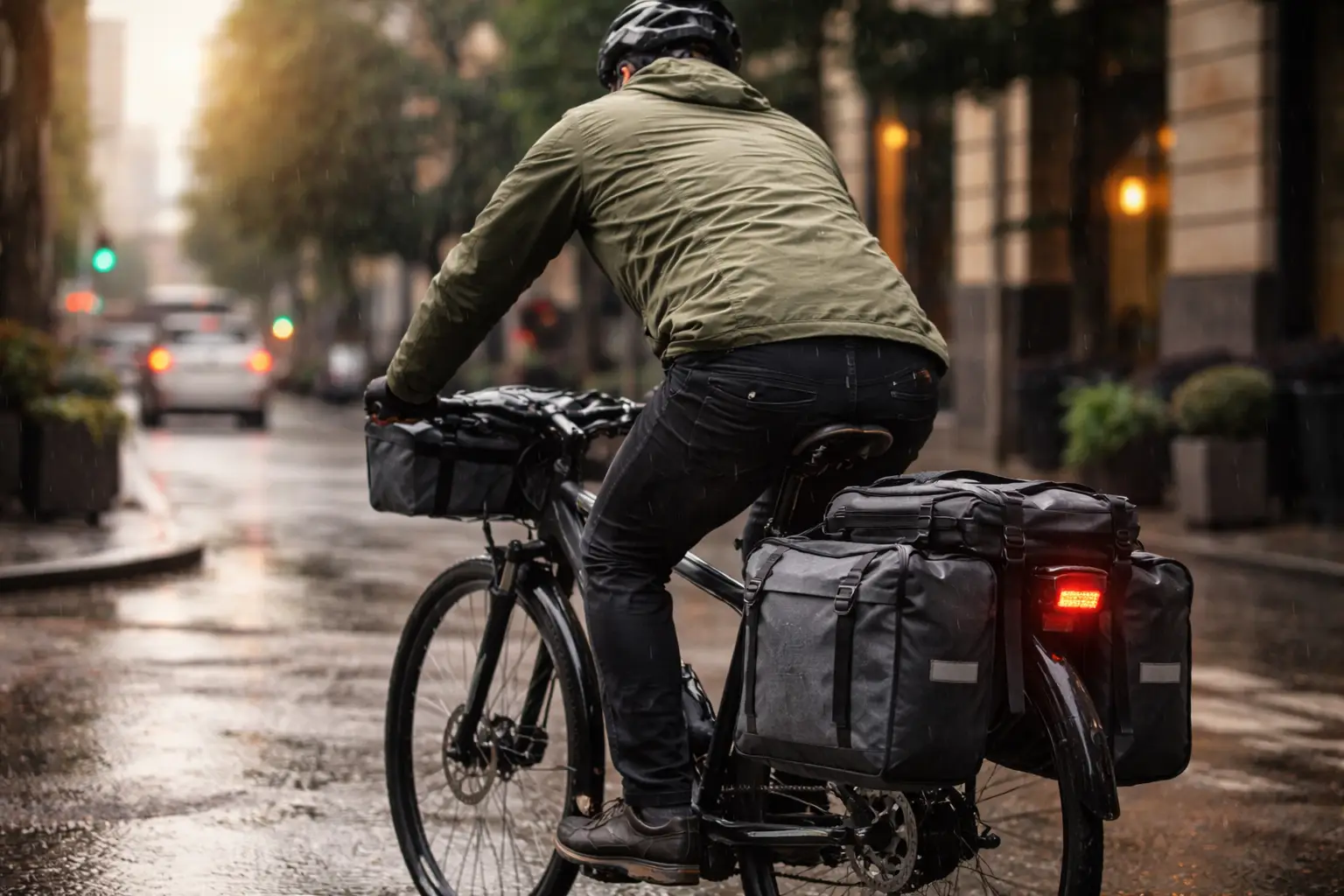
A real-world commuting scenario showing how waterproof bicycle pannier bags perform under daily urban riding and rain exposure.
1. Why Most Bicycle Bags Fail in Daily Commuting
Before choosing a bag, it is important to understand how and where failures occur. In daily commuting, failure almost always starts at interfaces, not at the main fabric panel.
Common early failure points include:
Zippers used under constant tension or contamination
Pannier hooks that develop play and begin to rattle
Seam tape lifting at corners and fold lines
Abrasion at bottom corners and rack contact zones
Once one interface degrades, the entire system accelerates toward failure. A loose hook increases vibration, vibration worsens abrasion, abrasion damages waterproof layers, and moisture then reaches the contents.
This is why durability must be evaluated as a system, not as a single feature.
2. Choosing the Right Bicycle Bag Type for Commuting
Best for daily loads above 4–5 kg. They keep weight off the body and reduce rider fatigue. Stability depends heavily on hook fit and lower stabilizer design.
Handlebar Bags
Ideal for light loads and quick access items. Steering feel changes rapidly above 3 kg, so they are not suitable for laptops or heavy gear.
Saddle Bags
Best for compact, lightweight commuting essentials. Above 2 kg, swing and strap stress increase significantly.
Hybrid or Modular Systems
Useful when loads vary day to day, but only if mounting tolerances are tight and modules are independently stabilized.
A mismatch between load and bag type is one of the most common causes of commuter dissatisfaction.
3. Load Capacity: How Much Weight Should a Bicycle Bag Carry?
Capacity labels are often misleading. A bag rated at 20 L does not mean it should be filled to its physical limit every day.
Practical commuter load guidelines:
0–2 kg: saddle or handlebar bag
3–5 kg: handlebar (upper range) or small pannier
6–10 kg: rear panniers with stabilizer
10 kg+: dual panniers or reinforced rack systems
Exceeding these ranges does not usually cause immediate failure. Instead, it increases zipper stress, hook fatigue, and seam creep—leading to early degradation.
A reliable commuter setup always includes load margin, not just load capacity.
4. Mounting Stability: The Difference Between Quiet and Chaos
Mounting stability determines both ride comfort and bag lifespan. Even small amounts of play become destructive under daily vibration.
Key indicators of a stable system:
Upper hooks sit firmly on the rack rail with no vertical lift
A lower stabilizer prevents rotational movement
The bag cannot be displaced more than 10–15 mm at the bottom when mounted
When a bag rattles, it is not just annoying—it is actively damaging both the bag and the rack. Long-term stability is achieved through tight tolerances, reinforced mount plates, and load-appropriate hook materials.
5. Waterproofing: What Actually Keeps Gear Dry
In commuting, rain exposure is not limited to top-down rainfall. Wheel spray, puddle splash, and prolonged dampness are far more demanding.
A simple paper-towel spray test at home often reveals weaknesses faster than any label.
6. Materials and Construction That Matter for Daily Use
Fabric choice alone does not determine durability, but it sets the baseline.
For daily commuting:
Mid-range denier fabrics with reinforced bases outperform ultra-light designs
TPU or laminated constructions resist abrasion better than thin coatings
Reinforcement patches at strap anchors prevent tear-out over time
Construction details—stitch density, reinforcement geometry, and edge finishing—are more predictive of lifespan than fabric name alone.
7. Zippers, Closures, and Daily Wear
Zippers fail in commuting not because they are inherently weak, but because they are misused as compression elements and exposed to dirt.
To extend closure lifespan:
Avoid packing hard objects directly against zipper lines
Maintain a closing margin rather than forcing full capacity
Rinse grit and salt after wet rides
For riders who regularly carry dense or bulky items, roll-top or flap-protected designs reduce long-term closure stress.
8. Fit, Clearance, and Frame Protection
A properly chosen bag should never contact the frame or interfere with pedaling.
Key checks before committing to daily use:
No heel strike during normal cadence
Adequate clearance under full load
No contact with frame stays during bumps
Frame rub is not just cosmetic damage—it indicates mounting instability that will shorten bag lifespan.
9. How to Test a Bicycle Bag Before Trusting It Daily
Before relying on a new bag for daily commuting, perform three simple checks:
Load Test: Pack to your real daily weight and check for rattle or rotation
Vibration Test: Ride rough surfaces and listen for movement or noise
Rain Test: Spray seams, corners, and closures for 10–15 minutes
Early warning signs usually appear within the first week.
10. When Budget Bags Work—and When They Don’t
Budget bicycle bags can perform acceptably when:
Loads remain under 4 kg
Riding frequency is low
Weather exposure is minimal
They fail fastest under daily commuting conditions with heavier loads, winter riding, and frequent rain. Understanding your use case is more important than price alone.
Conclusion: Buy for Interfaces, Not for Capacity
For daily commuting, the most important features of a bicycle bag are not size or style, but stability, interface durability, and weather resilience. Bags fail early when hooks loosen, seams lift, or closures degrade—not when fabric panels suddenly tear.
Choosing a commuter-ready bicycle bag means evaluating how it mounts, how it seals, how it handles vibration, and how it wears over time. When these factors are addressed, a bag becomes a reliable part of daily transportation rather than a recurring frustration.
FAQs
1. Why do bicycle bags fail faster in daily commuting than in occasional riding?
Daily commuting exposes bicycle bags to constant vibration, repeated loading cycles, curb impacts, and weather exposure. These stresses primarily affect interfaces such as zippers, mounting hooks, seams, and abrasion zones rather than the main fabric panels. Even small amounts of looseness or material fatigue can compound over time, leading to rattling, leaks, or structural wear. Occasional riding does not generate the same cumulative stress, which is why bags that seem fine at first often fail prematurely when used every day.
2. What type of bicycle bag is best for carrying a laptop to work?
For carrying a laptop, rear panniers are generally the safest option because they keep weight off the rider’s body and maintain better balance at higher loads. A commuter-ready pannier should have a stable hook system, a lower stabilizer to prevent sway, and internal padding or compartment separation to reduce impact forces. Handlebar bags and saddle bags are usually unsuitable for laptops due to steering instability and excessive swing under weight.
3. How can I tell if a bicycle bag mounting system is stable enough for commuting?
A stable mounting system should sit firmly on the rack without rattling or vertical lift. When mounted and loaded, the bottom of the bag should not move more than approximately 10–15 mm sideways when pushed by hand. The presence of a lower stabilizer clip or strap is critical for preventing rotational movement. If a bag produces noise during riding, it is usually a sign of mounting play that will accelerate wear over time.
4. Are waterproof bicycle bags necessary for daily commuters?
Waterproof bicycle bags are highly recommended for daily commuters, especially in urban environments where wheel spray, puddles, and prolonged damp conditions are common. Most water intrusion occurs at seams, zipper ends, and closure interfaces rather than through the main fabric. Bags designed for daily use typically protect openings, reinforce seam corners, and use construction methods that limit water ingress under continuous exposure.
5. How long should a well-made bicycle bag last with daily use?
With proper design and use, a well-made bicycle bag used for daily commuting should last multiple seasons. Longevity depends on load management, mounting stability, weather exposure, and maintenance. Early warning signs of reduced lifespan include developing hook play, zipper resistance, seam tape lifting at corners, and visible abrasion at contact points. Addressing these issues early can significantly extend usable life.
References
Urban Cycling and Load Dynamics, J. Wilson, Transport Research Laboratory, UK Transport Studies
Design Considerations for Bicycle Luggage Systems, M. Dufour, European Cycling Federation Technical Papers
Abrasion and Fatigue in Coated Textiles, S. H. Kim, Journal of Industrial Textiles, SAGE Publications
Water Ingress in Soft Goods Seams, T. Allen, Textile Research Journal, SAGE Publications
Ergonomics of Load Carriage in Cycling, P. de Vries, Human Factors and Ergonomics Society
Zipper Performance Under Repetitive Stress, YKK Technical Materials Report
Vibration Effects on Polymer Components, ASTM Technical Review Series
Urban Bicycle Commuting Safety and Equipment, UK Department for Transport Cycling Guidance
Why daily commuting exposes weaknesses in bicycle bags
Daily commuting transforms a bicycle bag into a mechanical system under constant stress. Unlike leisure riding, commuting introduces repetitive vibration, frequent mounting and removal, curb transitions, braking forces, and prolonged exposure to moisture and grit. These conditions accelerate fatigue at critical interfaces such as hooks, zippers, seam corners, and abrasion zones. Failures are rarely sudden; they emerge gradually as looseness, noise, leakage, or reduced stability.
How bicycle bag systems should be evaluated for commuting
A commuter-ready bicycle bag should be evaluated as a system rather than a container. Mounting tolerance, rotational control, load distribution, seam strategy, and closure protection collectively determine reliability. Stability under load, resistance to micro-movement, and controlled flex behavior are more predictive of lifespan than stated capacity or fabric branding. Proper evaluation includes load testing, vibration exposure, and water ingress checks focused on seams and openings.
What design features matter most in real commuting conditions
For daily use, practical features include tight-fitting hook systems, secondary stabilizers to control sway, protected openings to reduce water pooling, reinforced abrasion zones at corners and contact points, and construction methods that tolerate repeated flex cycles. These elements directly influence noise, wear rate, and moisture protection during everyday riding.
Options for different commuting profiles
Commuters carrying light loads on smooth routes may prioritize compact systems and quick access, while riders transporting laptops or heavy gear benefit from rear panniers with high mounting stability and internal load control. Weather-exposed routes favor structurally waterproof designs with protected closures, while high-frequency riders should prioritize repairable or modular hardware systems to extend product lifespan.
Key considerations before long-term daily use
Before committing to a bicycle bag for daily commuting, riders should confirm load margins, clearance under full weight, absence of mounting play, and resistance to water ingress at seams and openings. Early inspection during the first weeks of use often reveals whether a bag will remain reliable or degrade quickly under routine conditions.
Market and design trends shaping commuter bicycle bags
Recent trends emphasize structural waterproofing over chemical coatings, tighter mounting tolerances, replaceable hardware components, and improved visibility integration. As urban cycling grows and regulatory attention increases, commuter bicycle bags are increasingly evaluated on durability, safety, and lifecycle value rather than appearance alone.