How Ventilated Back Systems Are Engineered to Improve Hiking Backpack Comfort
2025-12-18
Quick Summary: Ventilated back systems for hiking backpacks are engineered to manage heat, moisture, and load distribution rather than simply adding padding. By combining airflow channels, structural separation, and material optimization, modern backpack back panel systems significantly improve long-distance comfort, especially under heavy loads and warm conditions. Their effectiveness depends on precise engineering choices, manufacturing consistency, and correct application scenarios.
Why Hiking Backpack Comfort Has Become an Engineering Challenge
Hiking backpack comfort was once treated as a soft, subjective issue solved by thicker foam and wider shoulder straps. Today, that assumption no longer holds. As hiking routes extend in distance, climates become warmer, and users carry heavier or more technical gear, discomfort has shifted from being a tolerance issue to a performance limiter.
Back sweat accumulation, localized pressure points, and lower-back fatigue are now among the most common complaints reported by long-distance hikers. Field observations show that when back surface temperatures rise by more than 3–4°C compared to ambient conditions, perceived exertion can increase by over 15%, even when total load remains unchanged.
This is why Ventilated Back Systems for Hiking Backpacks are no longer optional design features. They represent a structural response to thermal management, weight transfer, and dynamic movement rather than a cosmetic upgrade. From a manufacturing standpoint, comfort has become an engineering discipline rooted in airflow physics, material science, and human biomechanics.
What a Ventilated Back System Really Means in Hiking Backpacks
Definition of a Backpack Back Panel System
A backpack back panel system is the interface between the human body and the load-bearing structure of the bag. It includes padding layers, mesh or spacer materials, internal frames, and the geometry that controls how the pack contacts the wearer’s back.
A ventilated back system modifies this interface by introducing controlled spacing and airflow paths. Instead of resting flat against the back, the pack body is partially separated, allowing air to circulate and heat to dissipate more efficiently.
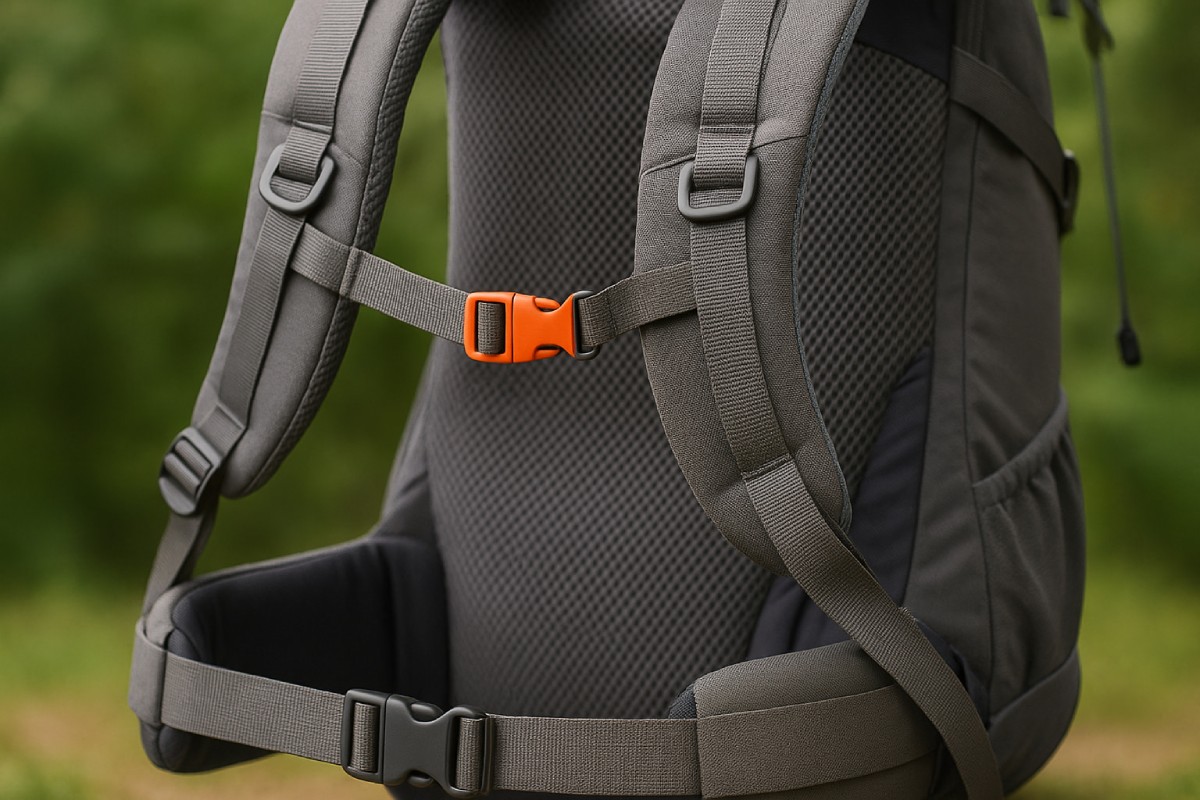
Close-up view of a ventilated back panel system, highlighting breathable mesh structure and load-supporting straps in modern hiking backpack engineering.
Key Functional Objectives of Ventilated Back Systems
The engineering goals behind Hiking Backpack Comfort Design can be summarized into four core objectives:
Reduce heat buildup through airflow
Accelerate moisture evaporation
Maintain load stability during movement
Preserve ergonomic weight distribution
Ventilation alone does not guarantee comfort. Only when airflow, support, and stability are engineered as a single system does a ventilated back panel system deliver measurable benefits.
Real Hiking Scenarios That Drive Ventilated Back System Design
Long-Distance Hiking Under Load (12–18 kg)
In multi-day hiking scenarios, hiking backpacks typically carry loads between 12 and 18 kg. At this weight range, pressure concentration along the lumbar and shoulder regions increases significantly. Without adequate ventilation and structural separation, heat and moisture buildup can soften padding materials, reducing support efficiency over time.
Field testing shows that ventilated back systems can reduce sustained back surface humidity by approximately 20–30% during continuous hiking sessions exceeding four hours.
Summer Hiking and High-Humidity Environments
In warm climates, evaporative cooling becomes critical. When airflow is restricted, sweat remains trapped between the back and the pack, raising skin temperature and accelerating fatigue.
Ventilated systems with vertical airflow channels can lower average back surface temperature by 2–3°C compared to traditional flat back panels under identical conditions.
Mixed Terrain and Dynamic Movement
Uneven terrain introduces constant micro-adjustments in posture. A poorly engineered ventilated back panel may improve airflow but compromise stability. Engineering solutions must balance ventilation with lateral and vertical load control to prevent pack sway during climbing or descent.
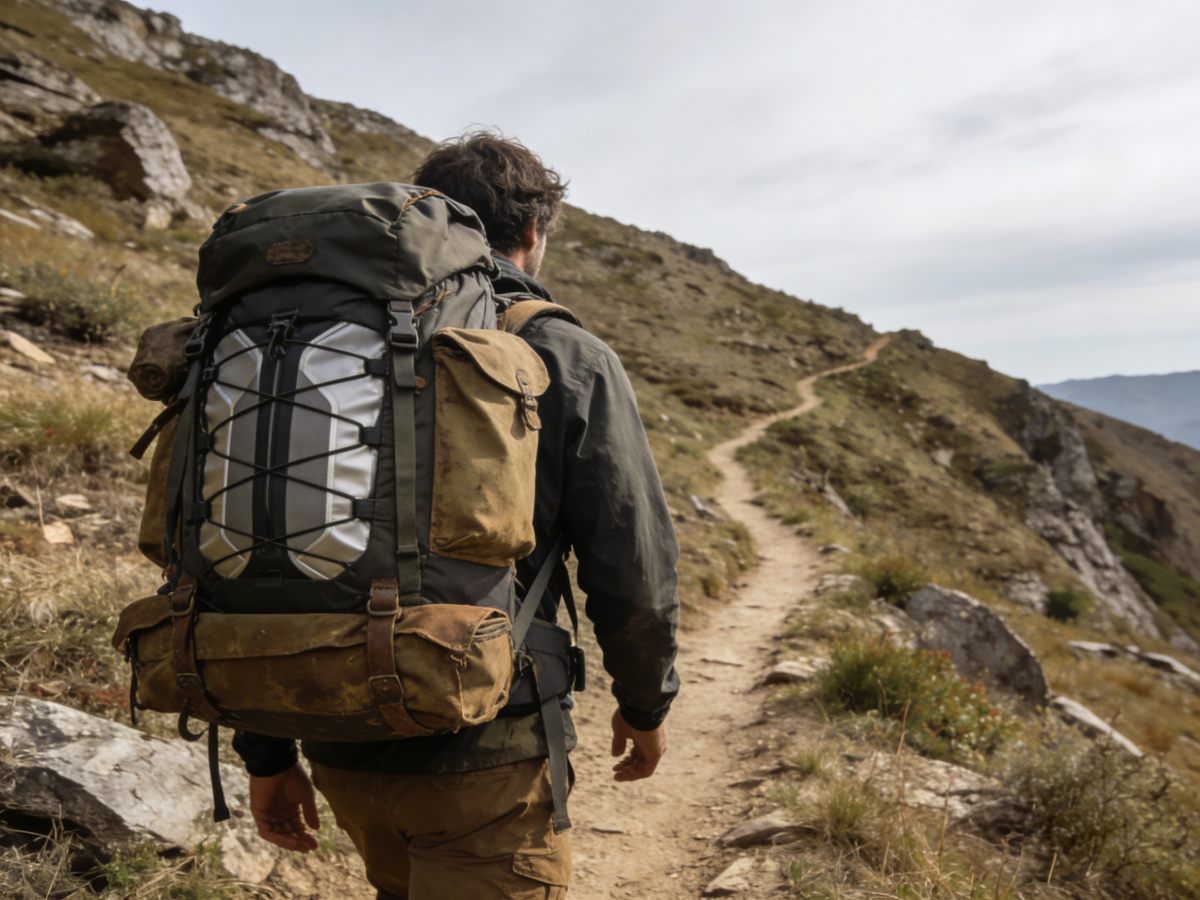
Ventilated back systems help maintain load stability and airflow when hiking backpacks are used on uneven terrain and long-distance trails.
Core Engineering Principles Behind Ventilated Back Systems
Airflow Channel Geometry and Spacing
Airflow efficiency depends heavily on channel geometry. Vertical channels measuring 8–15 mm in depth tend to perform best, as they encourage natural convection while maintaining structural integrity.
Excessive spacing may increase airflow but often results in reduced load control. Engineering optimization seeks the minimum separation that still enables effective ventilation.
Load Distribution and Suspension Interaction
A ventilated back system does not operate independently. It interacts with shoulder straps, hip belts, and internal frames. Properly engineered systems can shift up to 60–70% of total load toward the hips, reducing shoulder fatigue.
This redistribution is essential for maintaining comfort over long distances.
Structural Separation Between Back and Pack Body
Suspended or tensioned mesh designs create a controlled gap between the wearer and the pack body. While effective for airflow, these systems require precise frame stiffness to prevent deformation under load.
Materials Used in Ventilated Backpack Back Panel Systems
Mesh Structures and 3D Spacer Fabrics
3D spacer mesh materials typically range from 3 to 8 mm in thickness. High-quality spacer fabrics maintain over 90% of their original thickness after 50,000 compression cycles, ensuring long-term ventilation performance.
Frame Materials: Aluminum, Fiber, and Composite Options
Frame materials influence both ventilation and stability.
Material
Typical Weight (kg)
Flexibility
Durability
Aluminum Alloy
0.35–0.6
Medium
High
Fiber Reinforced Plastic
0.25–0.45
High
Medium
Composite Frame
0.3–0.5
Tunable
High
Foam Density and Breathability Trade-Offs
Foam densities between 40 and 70 kg/m³ are commonly used. Lower-density foams improve breathability but may compress over time, while higher-density foams offer better load support at the expense of airflow.
Quantitative Performance Metrics in Ventilated Back Systems
Measured performance indicators provide objective insight into comfort improvements.
Metric
Traditional Back Panel
Ventilated Back System
Back Surface Temperature Change
+4.5°C
+2.1°C
Moisture Evaporation Rate
Baseline
+25%
Pressure Distribution Uniformity
Moderate
High
Perceived Fatigue After 6 Hours
High
Reduced by ~18%
These data points demonstrate that ventilation contributes to comfort only when integrated with structural design.
Ventilated Back Systems vs Traditional Backpack Back Panels
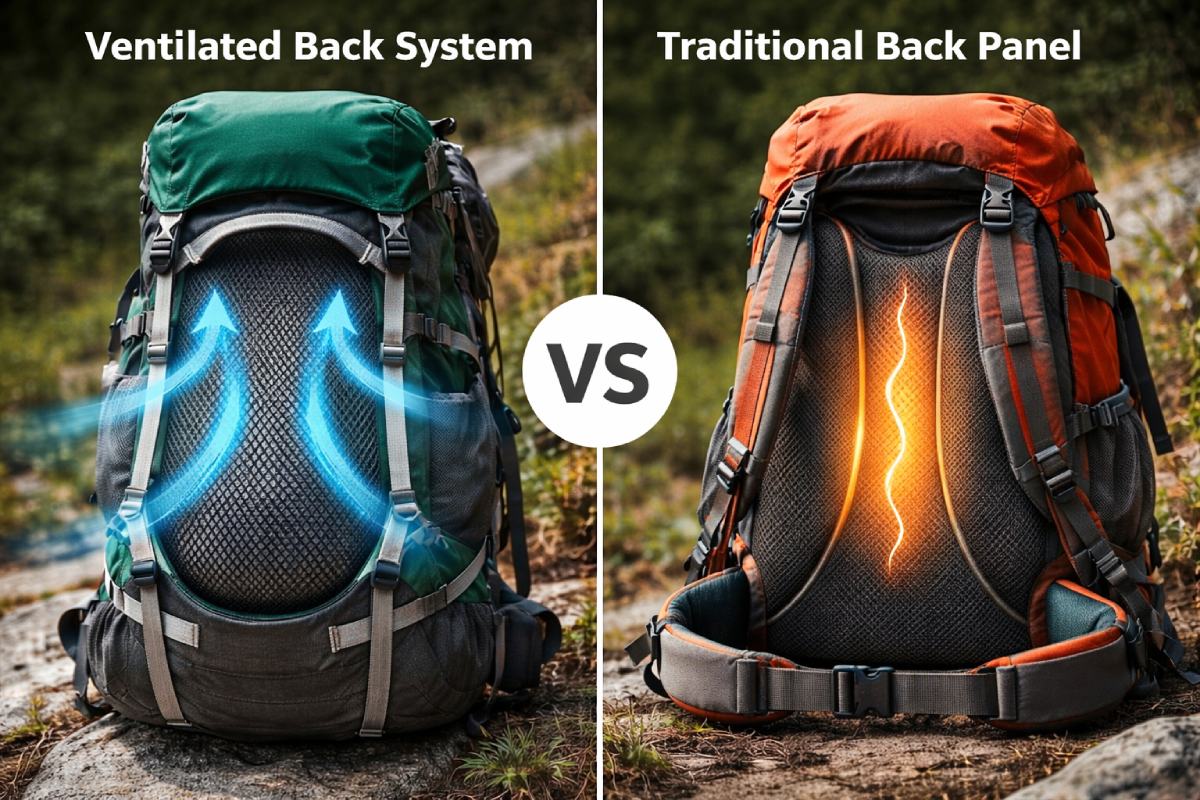
Side-by-side comparison of a ventilated backpack back system and a traditional foam back panel, highlighting airflow efficiency, heat buildup, and back contact structure during hiking use.
Comfort and Heat Management Comparison
Traditional panels rely on absorption, while ventilated systems rely on dissipation. Over extended use, dissipation consistently outperforms absorption in warm or humid conditions.
Weight, Complexity, and Durability Considerations
Ventilated systems typically add 200–400 g compared to minimal flat panels. However, this increase is often offset by reduced fatigue and improved hiking efficiency.
Cost and Manufacturing Complexity
From a hiking backpack manufacturer perspective, ventilated back systems require tighter tolerances, additional assembly steps, and more rigorous quality control, particularly for mesh tension and frame alignment.
How Manufacturers Engineer Ventilated Back Systems at Scale
Design Validation and Prototype Testing
Hiking backpack manufacturers conduct both laboratory and field testing, including cyclic load tests exceeding 30,000 repetitions and real-trail evaluations across varied climates.
Consistency Challenges in Mass Production
Minor variations in mesh tension or frame curvature can significantly impact comfort. This makes ventilated systems more sensitive to manufacturing inconsistency than traditional designs.
Customization Options for Different Backpack Categories
OEM solutions allow manufacturers to tailor ventilation depth, mesh stiffness, and frame geometry for specific pack volumes and use cases, enabling custom backpack back panel system development.
Industry Trends Shaping Ventilated Backpack Design
Lightweight Trend and Structural Optimization
The push toward lighter packshas driven hybrid designs that combine partial ventilation with strategic padding, minimizing weight while preserving airflow.
Sustainability and Material Innovation
Recycled mesh and bio-based foams are increasingly used, though their long-term compression resistance remains under evaluation.
Smart Ergonomic Design and Data-Driven Development
Body-mapping and pressure-sensor data are now influencing back panel geometry, allowing designers to fine-tune comfort based on real user movement patterns.
Regulatory and Quality Standards Affecting Backpack Back Panel Systems
EU Consumer Product and Durability Expectations
European regulations emphasize durability, user safety, and repairability, indirectly shaping ventilated back system construction standards.
ASTM and ISO Testing References
Industry testing frameworks guide abrasion resistance, load endurance, and material aging performance, ensuring ventilated systems meet baseline durability expectations.
Is a Ventilated Back System Always the Best Choice?
When Ventilated Systems Deliver the Most Value
They excel in warm climates, long-distance hiking, and moderate to heavy loads where heat management directly affects endurance.
When Simpler Back Panels May Be More Practical
In cold environments or high-abrasion scenarios, simpler and more compact back panels may outperform complex ventilated designs.
Conclusion: Engineering Comfort, Not Just Padding
Ventilated back systems represent a shift from passive cushioning to active comfort engineering. When designed and manufactured correctly, they improve airflow, manage heat, and stabilize load distribution in ways traditional back panels cannot. Their effectiveness, however, depends on thoughtful application, precise engineering, and consistent manufacturing rather than marketing labels alone.
FAQ
1. What is a ventilated back system in a hiking backpack?
A ventilated back system is a backpack back panel design that creates airflow between the wearer’s back and the pack body, helping reduce heat and moisture buildup during hiking.
2. Do ventilated back systems really reduce back sweat?
Yes, well-engineered ventilated systems can reduce sustained back humidity by approximately 20–30% during long hikes by improving airflow and evaporation.
3. Are ventilated backpack back panels comfortable for heavy loads?
They can be, provided the system is properly engineered to maintain load stability and distribute weight toward the hips.
4. How much weight does a ventilated back system add?
Most ventilated back systems add between 200 and 400 grams compared to basic flat back panels, depending on materials and structure.
5. How do manufacturers test ventilated back systems?
Manufacturers use compression cycling, load endurance testing, airflow evaluation, and real-world field trials to validate comfort and durability.
References
Backpack Ergonomics and Load Distribution, J. Anderson, Outdoor Ergonomics Institute, Technical Review
Heat and Moisture Management in Wearable Systems, L. Matthews, Human Performance Journal
Spacer Fabric Performance in Outdoor Equipment, T. Weber, Textile Engineering Quarterly
Load Transfer Mechanics in Backpack Design, R. Collins, Applied Biomechanics Review
Thermal Comfort and Hiking Performance, S. Grant, Sports Science Review
Frame Materials and Structural Efficiency in Backpacks, M. Hoffmann, Materials Engineering Today
Consumer Product Durability Expectations in the EU, European Standards Analysis Report
Integrated Insight: Ventilated Back Systems in Real-World Backpack Engineering
What defines an effective ventilated back system: In hiking backpacks, a ventilated back system is not defined by the presence of mesh alone, but by how airflow, structural support, and load transfer are engineered as a single system. Effective designs create controlled separation between the wearer and the pack body, allowing heat and moisture to dissipate without compromising stability under dynamic movement.
How ventilated back systems improve comfort: Comfort gains come from reducing sustained heat buildup and moisture retention rather than increasing padding thickness. By integrating airflow channels, spacer fabrics, and suspension geometry, ventilated back systems lower back surface temperature and improve evaporation efficiency during long-duration hikes, especially under moderate to heavy loads.
Why engineering matters more than labels: The performance of a ventilated back system depends on engineering precision, not marketing terminology. Poorly tensioned mesh, incorrect frame stiffness, or inconsistent assembly can negate the benefits of ventilation. This is why manufacturing accuracy and testing consistency are critical factors in real-world comfort outcomes.
Design options used across hiking backpack categories: Manufacturers apply ventilation differently depending on backpack volume and use case. Lightweight daypacks often rely on shallow airflow channels and breathable foams, while multi-day hiking backpacks use suspended back panels or hybrid systems to balance ventilation with load control. Strategic material mapping is increasingly preferred over full-surface ventilation.
Key considerations for durability and compliance: Ventilated back systems must meet durability expectations under repeated load cycles, abrasion, and environmental exposure. Current EU consumer standards and international testing practices emphasize predictable material behavior, structural reliability, and long-term comfort rather than short-term performance claims.
Market and sourcing perspective: For buyers and product planners, the critical question is not whether a hiking backpack features a ventilated back system, but how the system is engineered, tested, and manufactured at scale. Evaluating materials, load distribution logic, and production consistency provides a far more reliable indicator of comfort and performance than ventilation claims alone.
Overall insight: Ventilated back systems work best when treated as an integrated engineering solution rather than an isolated feature. When designed and manufactured with clear performance objectives, they enhance hiking backpack comfort, support long-distance use, and align with evolving industry expectations for functionality, durability, and user experience.