If your bike bag “wobbles,” “rattles,” or “kisses the wheel,” the fix is rarely a new bag—it’s the right bicycle bag stability accessories that remove play, control sway, and protect high-stress anchor zones. Stability is a system: rack stiffness + hook fit + lower restraint + compression + torque discipline. For most commuter loads (roughly 5–10 kg daily with occasional short peaks near 12–15 kg), a few P0 accessories—an anti-rattle pad for pannier, a pannier lower hook stabilizer, and a rack mounting spacer—can dramatically improve repeatability and reduce fatigue wear, especially on rough roads and in wet grit. For B2B buyers, the best “stability kit” is the one supported by verifiable tolerance control, replaceable hardware, and batch-level QC—so stability stays consistent across shipment lots, not just on one sample.
Bicycle Bag Accessories That Actually Improve Stability
Stability problems almost always show up the same way: your pannier swings wide when you stand up to pedal, your trunk bag chatters over brick pavement, a strap loosens and the bag starts drifting toward the wheel, or the load feels “heavier than it is” because it shifts at every bump.
The mistake most articles make is treating stability as a buying preference (“pick a better bag”). In real commuting and distribution programs, stability is an engineering outcome. It’s determined by how the bag interfaces with the rack, how tightly the hardware fits, whether the load is compressed, and whether the system stays consistent after thousands of vibration cycles.
This is where bicycle bag stability accessories matter. The right add-ons don’t just improve comfort; they reduce micro-motion, which is what turns moderate loads into long-term fatigue failures: hook deformation, fastener loosening, seam creep, and mounting plate wear.
If you’re sourcing for OEM bicycle bag accessories, building a product line, or running wholesale pannier accessories programs, the goal is not to list “more features.” The goal is to ship a stable system that stays stable across different racks, different rider habits, and different climates.
The Real Reasons Bike Bags Lose Stability
Micro-movement at the hook interface becomes big sway over bumps—this is the root of many pannier swinging fix and bicycle bag stability complaints.
Micro-Play Is the Hidden Enemy
A tiny amount of movement at the hook-rack interface can become loud, annoying, and destructive over time. In many real-world setups, even 2–3 mm of play at the hook can translate into repeated impact at every bump. That impact accelerates wear at the hook, backplate, rack tubing, and stabilizer.
Load Shape Can Create Side-Load Even at “Normal” Weights
A compact 8 kg load often behaves better than a rigid 6 kg box. Boxy cargo pushes outward and creates side-load that the mounting system must fight. If the bag bulges, hooks can be forced to twist, and lower anchors can be dragged out of alignment—classic pannier swinging fixterritory.
Vibration Turns “Static Strength” Into “Fatigue Failure”
Many load claims are essentially static. Real commuting is dynamic. Rough pavement, curb drops, and gravel convert a stable load into repeated micro-hammering. The bag may not tear, but hardware loosens, mounts creep, and the system becomes unstable.
Wet Road Spray Adds Abrasion and Contamination
Wet grit is not just “water.” It’s abrasive paste. It works into hook interfaces, strap ladders, and lower stabilizers, increasing friction and wear while also encouraging small slips that become big wobbles.
The Stability Stack: What to Fix First (P0 → P2)
Think of stability accessories in three tiers. P0 fixes prevent the most common failure modes. P1 upgrades noticeably improve ride feel and repeatability. P2 add-ons improve durability, safety, and long-term consistency.
P0: Fix the Interface (Rattle, Swing, Wheel Rub)
These address the biggest stability killers: loose hook fit, missing lower restraint, and uncontrolled load shift.
P1: Control the Load (Compression, Balance, Heel Clearance)
These reduce sway triggers: bulge, imbalance, and rider-induced movement.
P2: Protect the System (Wear Shields, Corrosion/Weather, Visibility)
These reduce long-term degradation: abrasion at corners, strap slip in wet grime, and hardware corrosion.
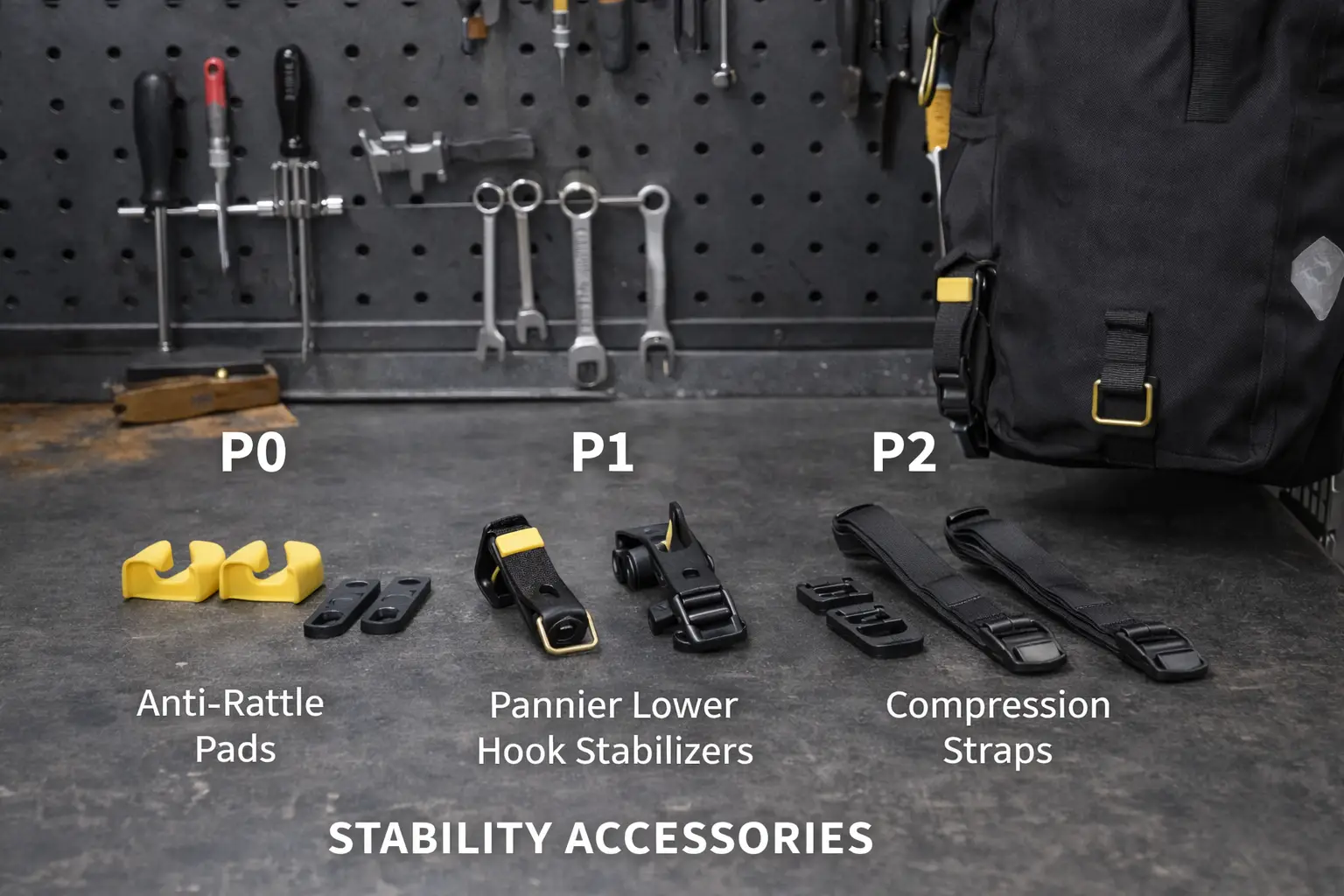
A visual breakdown of P0, P1, and P2 stability accessories for bike bags: from anti-rattle pads to pannier stabilizers and compression straps, showcasing how each level improves bike pannier stability.
Comparison Table: Accessories That Actually Improve Stability
Accessory (What it is)
The problem it fixes
Typical materials
Best load range impact
Weather suitability
Best commuting scenario
anti-rattle pad for pannier / hook shim
Eliminates micro-play, reduces noise and impact wear
This table is also a procurement checklist in disguise: if a supplier can’t describe how their hardware eliminates play and resists loosening, stability claims are usually cosmetic.
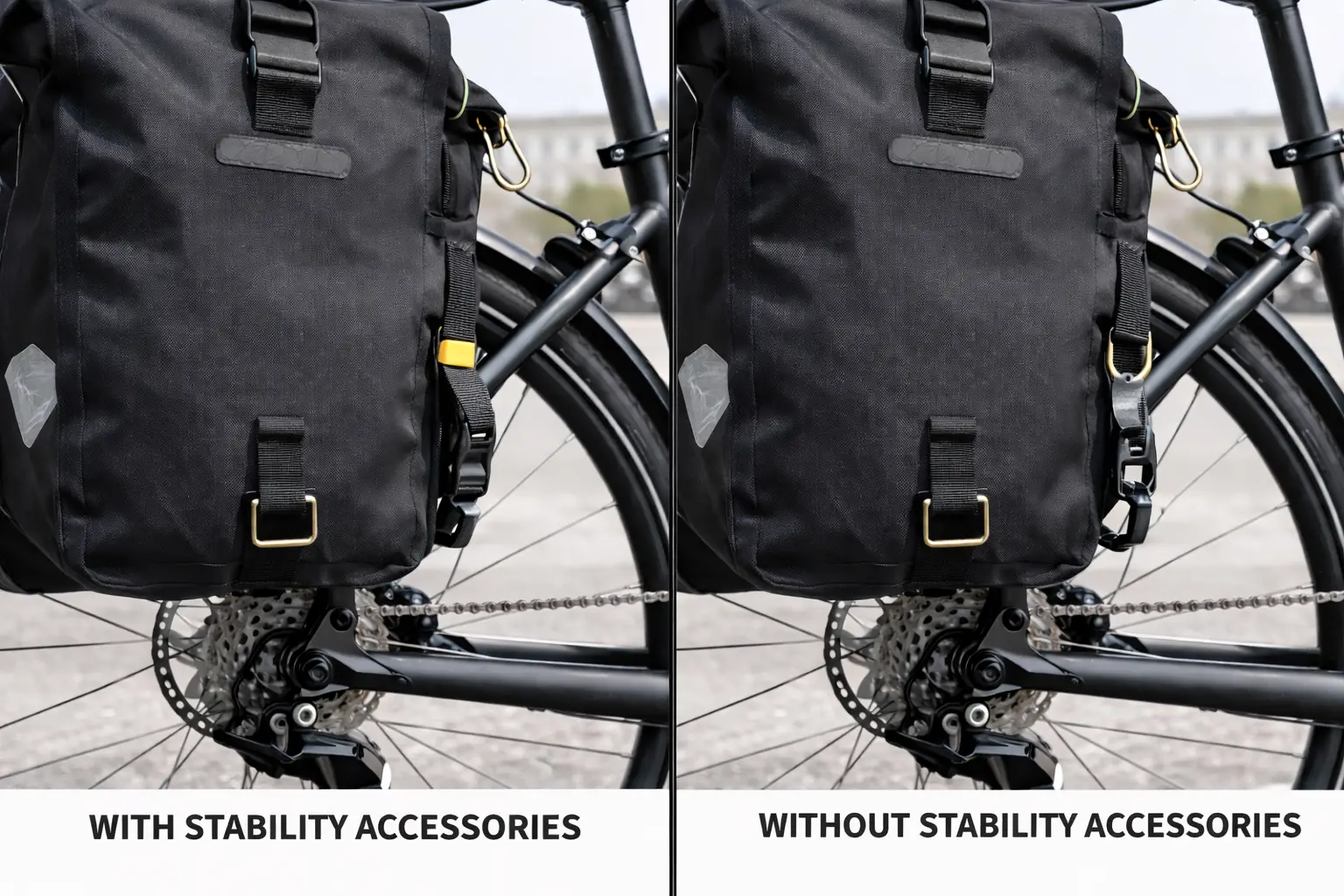
A direct comparison between a pannier bag with anti-rattle pad and lower hook stabilizer, and one without—demonstrating improved stability and reduced rattle and sway.
Accessory Deep Dive: What Works, Why It Works, and When It Backfires
anti-rattle pad for pannier: The quickest stability win
If your bag rattles, it’s not just annoying—it’s destructive. Micro-motion turns into repeated impact. A well-designed anti-rattle insert increases friction and removes slack so the hook doesn’t “clack” against the rack.
When it matters most
rough roads and curb drops
lighter racks that flex slightly
commuter loads that look “fine” but feel unstable
What to watch for
inserts that are too soft can compress and lose effectiveness
inserts that are too hard can wear rack tubing faster
grit contamination: choose materials that don’t become sandpaper when wet
pannier lower hook stabilizer: The true sway killer
If you only add one stability accessory besides a rattle pad, make it a lower restraint. Upper hooks carry weight; lower stabilizers control rotation and lateral swing. This is the accessory that solves bike bag rubbing wheel and “swinging pannier” complaints.
Why it works
A lower stabilizer reduces the moment arm that lets the bag rotate. Even modest loads (5–8 kg) can cause noticeable swing if the lower section is uncontrolled.
Real-world constraint
Some racks and frames have limited lower mounting space. For B2B programs, compatibility documentation is not optional—it’s part of the product.
rack mounting spacer: Compatibility is stability
A hook that fits perfectly on one rack can wobble on another if tubing diameter or shape differs. A rack mounting spacer (or insert) is not a cosmetic accessory; it’s a tolerance management tool.
Why B2B buyers should care
When your customers mount the same bag on different racks, stability becomes a distribution problem. Spacers reduce returns caused by “doesn’t fit” or “wobbles on my rack.”
compression straps for bike bags: Reduce bulge, reduce side-load
Boxy cargo creates side-load that fights your mounting system. Compression straps reduce bulge and keep the load compact, lowering sway triggers.
The trade-off
Over-compression can create hard edges that press into corners and seams. For stability, you want “controlled compression,” not “crush everything.”
A bag can be designed well and still fail in the field if fasteners loosen. For stability, the accessory is not only “better screws.” It’s the right washer stack, locking strategy, and installation discipline.
Useful torque guidance (typical, not universal)
Many common M5 rack fasteners are often tightened in the neighborhood of 4–6 N·m
Many common M6 rack fasteners are often tightened in the neighborhood of 6–10 N·m Always follow the rack and hardware supplier’s specification; the point is consistency. Loose hardware creates rattle, and rattle creates fatigue.
replacement pannier hooks: Don’t ignore wear life
Hooks and contact surfaces wear. When they wear, play increases. When play increases, stability collapses.
This is why replaceable hooks are a B2B-friendly feature: you can restore stability without replacing the entire bag, reducing warranty cost and improving customer satisfaction.
Stability in Real Scenarios (Where Accessories Earn Their Keep)
Stop-and-go commuting with frequent mounting and unmounting
Frequent removal and reattachment increases the chance of imperfect seating. The stability winners here are:
anti-rattle pad for pannier to remove slack quickly even with rushed mounting
rack mounting spacer to keep fit consistent across racks
a simple torque check routine to prevent gradual loosening
Grocery runs with rigid containers and uneven loads
This scenario creates the most sway complaints because rigid cargo bulges and uneven loads create yaw.
balance discipline: aim to keep left-right difference within roughly 10–15% when possible
Wet-road commuting with gritty spray
Wet grit attacks straps and hook interfaces. Stability becomes a wear management problem:
choose corrosion-resistant fasteners in a pannier mounting hardware kit
clean and rinse stabilizers periodically
avoid accessories that trap grit in crevices without drainage
Touring and multi-day loads
Even if loads aren’t “huge,” long distance means repetition. The value shifts to:
redundancy (secondary stabilizer strap)
replaceability (replacement pannier hooks)
fastener consistency (locking strategy)
A Simple Field Test Protocol (B2B-Friendly, Low-Drama, High-Value)
Step 1: The 10-second shake test
Mount the bag and shake laterally. Any audible clack or visible shift suggests play at the interface. This is where anti-rattle pad for pannier and rack mounting spacer show immediate value.
Step 2: The curb-drop reality check
With a moderate load (around 6–8 kg), roll off a small curb at low speed. If the bag swings and doesn’t settle quickly, you likely need a pannier lower hook stabilizer and better compression.
Step 3: The wheel-clearance check
After mounting, look for minimum clearance between bag and wheel. If the bag can drift toward spokes, fix that before increasing load. Many “capacity” issues are actually bike bag rubbing wheel issues.
Step 4: The loosening audit
After a week of riding, re-check fasteners. If you see rotation or backing out, your stability problem is installation and locking strategy, not fabric strength.
Procurement Notes for B2B Buyers (Manufacturer/Factory Conversations That Matter)
If you’re evaluating a manufacturer or factory for accessories, stability features must be supported by repeatable control, not just design intent.
What to ask a supplier (without turning it into a sales pitch)
What rack tubing diameters are supported, and what spacer system is provided?
What is the tolerance approach for hook fit (how do you prevent play)?
Are replacement pannier hooks available, and how are they installed?
What fastener materials are used (corrosion resistance), and what locking strategy is recommended?
How are stabilizer components tested for wear under wet grit exposure?
For OEM programs, your accessory story becomes part of your product’s durability promise. For wholesale programs, it becomes part of your return-rate management.
Industry Trend: Why “Stability Accessories” Are Becoming a Real Category
Commuting loads are becoming heavier and more frequent: laptops, locks, meal prep containers, and daily groceries. Riders also demand quieter, tighter setups. That shifts competitive advantage away from “denier bragging” and toward system stability:
tighter mounting tolerance (reduced play)
more refined stabilizers
replaceable hardware ecosystems
better documentation for compatibility
For B2B, this is good news: accessories are a scalable way to raise product satisfaction without forcing customers to upgrade to a larger bag.
Conclusion
If you want stability, don’t start by chasing a bigger bag or a higher “kg” claim. Start by removing play, controlling swing, and compressing the load. The highest ROI stability stack is usually P0: anti-rattle pad for pannier, pannier lower hook stabilizer, and a rack mounting spacer matched to real rack variation. Then add P1 control: compression straps for bike bags, heel clearance adjustment, and hardware discipline with a pannier mounting hardware kit.
For B2B programs, stability accessories are not add-ons—they are system controls. The most durable product lines are the ones that treat stability as a repeatable outcome across racks, routes, seasons, and shipment lots.
FAQs
1) What are the most effective bicycle bag accessories to stop pannier swinging?
The fastest fix for swinging is adding a pannier lower hook stabilizer because it controls rotation and lateral movement that upper hooks alone can’t prevent. Pair it with an anti-rattle pad for pannier to remove micro-play at the top interface, and add compression straps for bike bags if bulging cargo is creating side-load. The combined effect is a bag that settles quickly after bumps instead of continuing to sway.
2) Why does my bike bag rattle even when it feels “secure”?
Rattle usually comes from small gaps—often just a few millimetres—between hooks and rack tubing. Those gaps become repeated impacts on rough pavement, which sounds like looseness even if the bag doesn’t fall off. A rack mounting spacer or anti-rattle pad for pannier fills that gap and increases friction so the hook doesn’t clack. If rattle returns quickly, check fasteners and consider a pannier mounting hardware kit with a consistent locking strategy.
3) How do I prevent a bike bag from rubbing the wheel or spokes?
Wheel rub is typically a geometry and restraint issue, not a “capacity” issue. Use a pannier lower hook stabilizer to stop the bottom from drifting inward, verify correct hook placement so the bag sits flat, and ensure you have sufficient clearance at full load. If the rack is narrow or the bag sits too low, adjust mounting rails or use a compatible spacer solution. Avoid increasing load until the bag stays centred during a shake test and a low-speed curb drop.
4) Do compression straps really improve stability, or are they just for shaping?
They improve stability when used correctly. Compression straps for bike bags reduce bulge, keep cargo compact, and prevent shifting, which reduces side-load that twists hooks and mounts. The key is controlled compression: enough to stop movement, not so much that you create hard edges pressing into seams and corners. For rigid cargo like meal containers, straps can be the difference between a stable ride and constant sway.
5) What should B2B buyers ask a manufacturer about stability accessories and hardware?
Ask for compatibility logic and tolerance control, not marketing claims. A supplier should specify supported rack tubing sizes, provide a spacer system, and explain how they minimise play at the hook interface. Confirm whether replacement pannier hooks are available, what fastener materials are used for corrosion resistance, and what installation discipline is recommended (including locking strategy and re-check intervals). For OEM bicycle bag accessories and wholesale pannier accessories programs, also ask how batch QC verifies hook alignment and stabiliser consistency across lots.
References
ISO 11243: Cycle luggage carriers — Requirements and test methods, International Organization for Standardization (ISO), ISO Standard Publication.
ISO 12947 (Parts 1–4): Textiles — Determination of the abrasion resistance of fabrics by the Martindale method, International Organization for Standardization (ISO), ISO Standard Publication.
ASTM D3884: Standard Test Method for Abrasion Resistance of Textile Fabrics (Rotary Platform, Double-Head Method), ASTM International, ASTM Standard Publication.
ASTM D751: Standard Test Methods for Coated Fabrics, ASTM International, ASTM Standard Publication.
Bicycle Maintenance: Fasteners, Torque, and Assembly Practices (Technical Articles), Park Tool (Technical Education), Park Tool Publications.
Corrosion Basics and Salt-Spray Performance of Metal Components (Industry Guidance), AMPP (Association for Materials Protection and Performance), AMPP Technical Guidance.
Plastics Weathering and Durability: UV Exposure and Aging Mechanisms (Technical Papers), Society of Plastics Engineers (SPE), SPE Publications.
Bicycle Bag Stability: A Systematic Approach
What: The stability of bicycle bags is a combination of well-designed hardware and functional accessories. Effective accessories like the anti-rattle pad, pannier lower hook stabilizer, and compression straps are designed to eliminate micro-movements that lead to long-term wear and instability in pannier setups.
Why: Without these stability accessories, even the most well-designed bike bags are susceptible to issues like swinging panniers, rattling noise, or rubbing against the wheel. These problems are mainly due to the lack of appropriate restraints and the shifting of the load, causing unnecessary stress on hooks and mounting hardware.
How: To fix stability issues, start with the P0 accessories that eliminate immediate instability—like anti-rattle pads and lower hook stabilizers. For better long-term performance, add P1 and P2 accessories that prevent load shift and reduce wear over time, ensuring the bag stays stable through thousands of commuting cycles.
Options: If you’re sourcing these accessories for OEM programs or wholesale distribution, choose components that ensure long-lasting reliability under various commuting conditions. Materials such as abrasion-resistant rubber, reinforced polymers, and corrosion-resistant fasteners are essential for creating a stable and durable system.
Buyer Consideration: For B2B buyers, ensuring repeatable stability across racks, customer loads, and seasons is key. Ask suppliers for documentation proving hardware compatibility, stability tests, and batch-level quality control to avoid inconsistencies and returns.