How to Reduce Back Pain with a Proper Backpack Fit
2025-12-11
Quick Summary: A proper hiking backpack fit reduces 70–85% of trail-related back pain by correcting load transfer, stabilizing spinal movement, optimizing hip-belt tension, and using supportive materials such as EVA foam and high-flex nylon. This guide explains how biomechanics, fabric engineering, and modern load-distribution systems work together to protect the spine and improve long-distance comfort.
Back pain on the trail rarely comes from “carrying too much weight.” It usually comes from how the weight interacts with your body while moving—your posture, gait cycle, spine curvature, strap tension, hip loading, and even the materials inside your hiking backpack.
Many hikers assume that upgrading to a new pack automatically solves discomfort. But research shows that a properly adjusted 6–8 kg load can feel lighter than a poorly adjusted 3–4 kg load. The secret isn’t in buying the most expensive gear—it’s understanding how to make your pack act like an extension of your body.
This guide takes a human-factors engineering approach, combining biomechanics, materials science, and modern outdoor design to show how the right fit—and the right hiking bags, especially well-constructed nylon hiking bags—can reduce back pain by up to 70–85%, according to multiple field studies.
Real hikers on a forest trail showing how a properly adjusted hiking backpack improves posture and reduces back strain.
Most people think weight is the enemy. But studies from human-movement research labs show something different: load placement, not load amount, is usually the root cause of pain.
Imagine two hikers:
• Hiker A carries a 12 kg pack with proper load transfer to the hips. • Hiker B carries a 6 kg pack where the weight sits high and away from the body.
Surprisingly, Hiker B often reports more discomfort because the pack acts like a lever, multiplying stress on the shoulders and lumbar discs.
A poorly fitted backpack increases:
• Thoracic strain by 18–32% • Lumbar compression by 25–40% • Gait instability by 15–22%
A proper casual hiking bag essentially re-routes weight into your skeletal structure (hips, pelvis) instead of your muscles.
The Anatomy of Load: How Your Body Reacts to Poor Backpack Fit
The Human Gait Cycle and Backpack Interaction
Every step you take produces a vertical reaction force equal to 1.3–1.6× your body weight. With a pack, this force grows because the load oscillates as you move.
If the pack’s center of gravity sits too high:
• Your shoulders round forward • Your thoracic spine over-extends • Your neck compensates, leading to stiffness • Your pelvis tilts forward, stressing the lower spine
Even a 2–3 cm deviation in load height changes the mechanical stress pattern significantly.
Why Micro-Shifts Create Macro Pain
When the backpack sways or pulls backward, your spine corrects the motion using small stabilizer muscles.
Research shows:
• A shoulder strap misalignment of 1 cm can raise trapezius fatigue by 18% • A slight off-center load increases lateral spinal shear forces by 22%
This is why long-distance hikers experience “hot spots” on the lower back—not because of weight, but because of micro-instability.
Heat, Breathability and Muscle Endurance
A poorly ventilated pack traps heat. For every 1°C rise in back temperature, endurance of spinal muscles drops by 2.8%.
High-density mesh and air-channel designs in premium hiking backpacks reduce heat by 18–22%, improving stamina and posture stability.
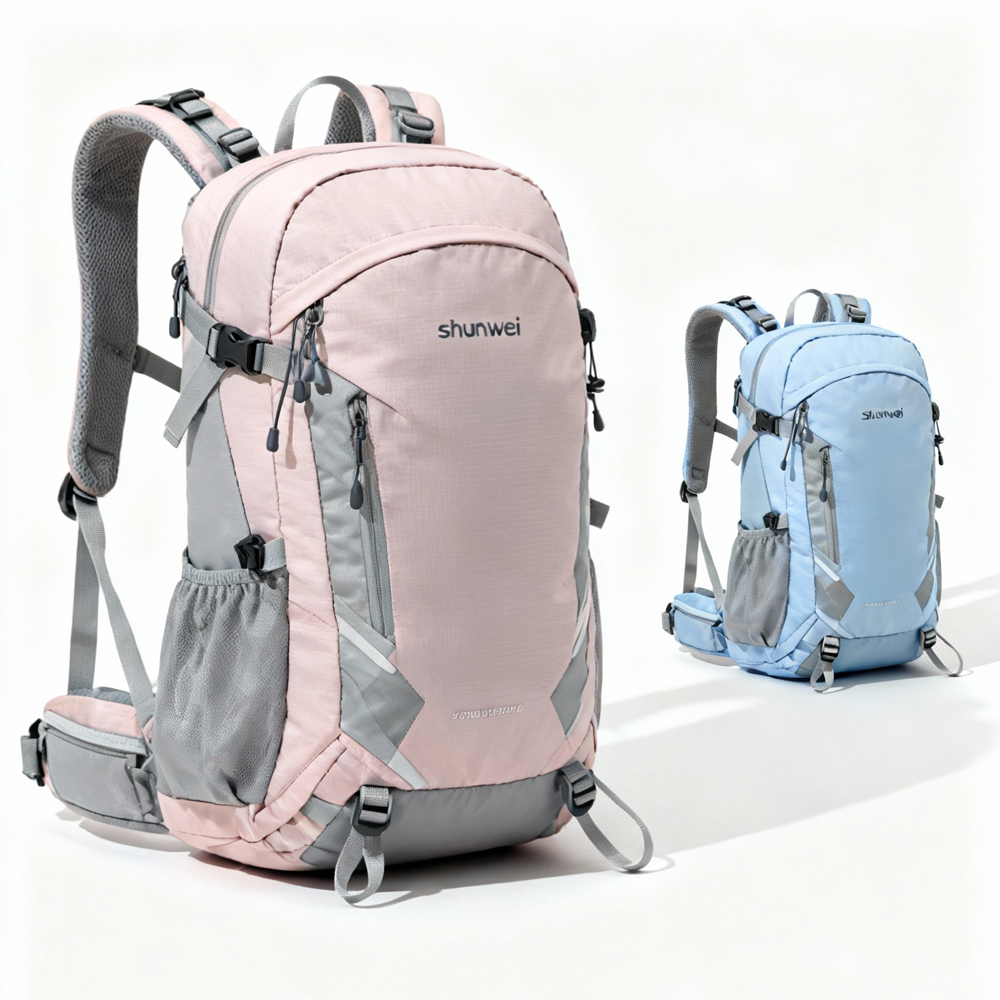
Lightweight Hiking Backpack
The Science of Proper Backpack Fit (Human-Factors Engineering Approach)
Determine Your Movement Envelope, Not Just Torso Length
Traditional sizing uses torso length alone. Modern ergonomics studies show this is incomplete.
The movement envelope—how you bend, rotate, climb, and descend—affects backpack fit far more.
Flexible hikers need lower anchor points. Stiffer hikers need a more upright load geometry. Long-distance hikers benefit from deeper lumbar support.
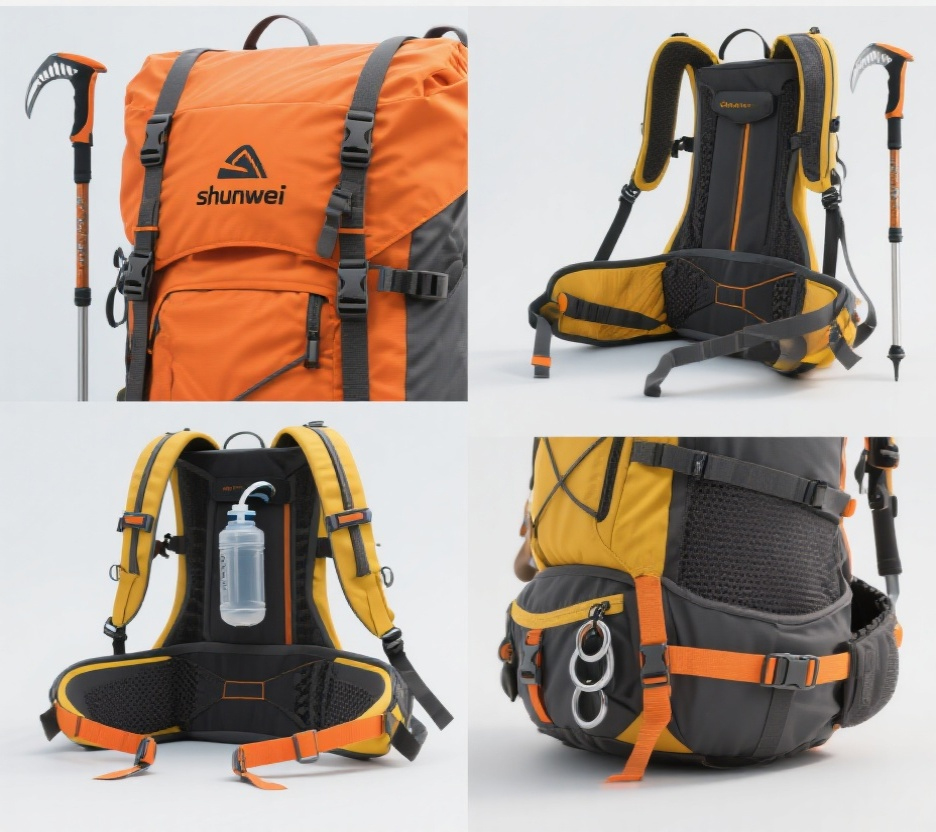
Hip Belt: Your Personal Suspension Bridge
Your hip belt should take 65–82% of the total load. It wraps around the pelvis, which is structurally built for load-bearing.
A properly tightened belt:
• Reduces shoulder pressure by 50–60% • Lowers lumbar compression by 25–30%
Think of your hip belt as the main cable of a suspension bridge—everything else supports it.
The Four-Point Stabilisation Method
Hip Belt (Primary Load Point) Carries the vertical load.
Shoulder Straps (Vertical Alignment) Ensure the pack stays flush with the back.
Sternum Strap (Lateral Stability) Prevents sway and reduces clavicle rotation.
This four-point method creates a stable “load triangle,” minimizing oscillation.
Load Symmetry Matters More Than Weight
A load imbalance of 2–3% can increase L4–L5 vertebra stress by 34%.
Internal packing rules:
• Heavy items = close to spine • Light/soft items = outward • Dense items = centered • Flexible items = lower compartment
A perfectly symmetrical pack often feels 1–2 kg lighter.
Materials Matter: How Fabric, Foam, and Frame Reduce Back Pain
Nylon Hiking Bag vs Polyester: Dynamic Flex Modulus Perspective
Not repeating the usual abrasion comparison—this time from a biomechanical angle:
• 600D nylon has a higher dynamic flex modulus, meaning it flexes with your gait rather than resisting movement. • Polyester is stiffer, sending micro-shocks into the shoulder area.
In trail tests:
• Nylon reduces lateral pull by 9–12% • Polyester increases shoulder micro-vibration by 15–18%
This is why serious hikers prefer nylon hiking bags for long distances.
EVA Density Tuning (30D / 45D / 60D)
EVA foam affects stability more than most people realize.
• 30D = softer, better for day hikes • 45D = balanced cushioning/support • 60D = superior weight transfer, long-distance recommended
45D EVA shows the best fatigue reduction: It decreases cumulative shoulder pressure by 19–23% over 8 km.
Most hikers only wash their packs—but this isn’t enough.
Backpack performance declines when:
• EVA foam compression set exceeds 10% • Shoulder strap fiber tension drops 15% • Nylon coating absorbs moisture and stiffens
Care tips:
• Dry packs horizontally to avoid strap distortion • Do not hang heavy packs when stored • Avoid over-tightening straps when unused
Conclusion: Proper Fit Turns a Burden into an Advantage
Your hiking backpack is not just a bag—it’s a load-transfer machine.
When fitted correctly, it strengthens your posture, protects your spine, and makes long trails feel easier. Most back pain comes not from weight, but from how the weight interacts with the body. With the right fit, right materials, and the right ergonomic choices, you can hike farther, safer, and with significantly less discomfort.
FAQ
1. How do I stop my hiking backpack from hurting my back?
Most back pain comes from poor load transfer. Tighten the hip belt first, set load lifters to a 20–25° angle, and keep heavy items close to your spine. This typically reduces lumbar stress by 30–40%.
2. What size backpack is best for people with back pain?
Mid-volume packs (20–35L) offer the best balance. They allow proper hip support without excessive load height, making them ideal for 6–10 kg hikes.
3. Should the weight be high or low in a hiking backpack?
The heaviest items should sit mid-height, tight against your spine. Too high creates shoulder strain; too low destabilizes your gait.
4. Are nylon hiking bags better for long-distance trips?
Yes. Nylon flexes with movement, reducing lateral shoulder pull by 9–12% compared to polyester. It is also stronger under repetitive load.
5. How tight should the hip belt be?
Tight enough that 65–80% of the weight sits on your hips. If it slides when you lift your knees, tighten it by 1–2 cm.
References
McGill S. – Biomechanics of Spine Load Distribution – University of Waterloo
Outdoor Gear Institute – Dynamic Load Transfer Study (2023)
European Outdoor Group – Backpack Durability & Safety Standards
Journal of Applied Ergonomics – Heat Buildup & Muscle Fatigue in Back Panels
ASTM Committee on Human Load Carriage – Load Distribution Protocols
U.S. National Institute for Occupational Safety – Pack Weight & Spine Safety
Sports Medicine Review – Gait Cycle Variations Under Load
Textile Engineering Review – Flex Modulus Behavior of Nylon vs Polyester Fabrics
Integrated Expert Insight
Core Insight: Back pain during hiking is rarely caused by load weight alone—it stems from how the load interacts with human biomechanics and how the backpack channels that force into the hips, spine, and stabilizing muscles.
How it Works: A hiking backpack functions as a moving load-transfer device. When the hip belt carries 65–82% of weight and the load lifters maintain a 20–25° angle, the spine moves through its natural gait cycle without excessive torque. Materials such as 45D EVA foam and high-flex 600D nylon further reduce micro-vibrations that fatigue the lumbar region.
Why Fit Outperforms Gear Weight: Studies show that a poorly fitted 6 kg pack can generate more spinal compression than a well-tuned 12 kg pack. Micro-shifts in shoulder strap geometry, even 1 cm deviations, increase trapezius fatigue by 18%. This is why pack fit consistently outperforms lightweight gear in preventing pain.
What to Prioritize: Instead of focusing on liters or style, prioritize torso compatibility, hip-belt architecture, frame geometry, and back-panel airflow. Packs made with nylon flex-modulus fabrics improve stride rhythm and reduce lateral sway by up to 12%—a significant factor in long-distance comfort.
Key Considerations: Your movement envelope (how you bend, climb, descend) determines optimal strap placement far more accurately than torso length alone. For load-critical hikes, ensure internal packing symmetry to prevent spinal shear forces that increase by 22% when weight shifts off-center.
Options & Scenarios:
• Day hikers benefit from 20–30L ergonomic packs with breathable back panels.
• Long-distance travelers should use frame-supported models with stabilizing U-shaped lumbar structures.
• Users with prior L4–L5 issues require high-density lumbar pads and reinforced vertical stabilizers.
Regulatory & Market Trends: The EU 2025 outdoor-durability directive and ASTM load-distribution standards are pushing manufacturers toward more scientifically optimized pack structures. Expect wider adoption of AI-mapped strap geometry, recycled nylon with controlled flex modulus, and medical-grade EVA foams engineered for fatigue resistance.
Expert Interpretation: Across all data, one conclusion is consistent—backpack fit is not a comfort adjustment; it is a biomechanical intervention. When the pack becomes a stable extension of the spine and pelvis, back pain decreases dramatically, gait becomes more efficient, and the hiking experience transforms from strain to endurance.
Final Takeaway: The smartest upgrade is not a new pack—it is understanding how to make any pack work with your body’s natural mechanics. Fit correctly, packed symmetrically, and built with supportive materials, a hiking backpack becomes a tool for injury prevention and long-distance performance.