Quick Summary: This 2026 buyer-focused ranking explains the **best bicycle bags for commuting 2026** using real urban scenarios (5–18 km routes, rain days, multi-modal travel), quantified specs (load in kg, fabric denier, waterproof performance, reflective %), and category picks (backpack, pannier, waterproof roll-top, laptop-ready, lightweight). It highlights what matters most in **bicycle bags for commuting**—stability, weatherproofing, and visibility—plus practical manufacturing cues for buyers looking at **bicycle bag manufacturer**, **bicycle bag factory**, **commuter bike bag wholesale**, and OEM-ready options.
Introduction: Why Commuting Bicycle Bags Matter More in 2026
Urban commuting in 2026 is no longer a niche lifestyle choice—it is a daily mobility solution shaped by traffic congestion, environmental policy, and the rapid adoption of e-bikes. For millions of riders, the bicycle is now a primary transport tool rather than a recreational option. In this shift, bicycle bags for commuting have become a critical piece of everyday equipment, directly influencing safety, efficiency, and long-term riding comfort.
Unlike casual cycling accessories, commuting bicycle bags operate under constant stress. Daily loads typically range from 3 kg to 9 kg, exposure to rain can exceed 30% of annual riding days in major cities, and repeated mounting cycles often surpass 1,000 uses per year. In 2026, the difference between a reliable commuter bag and a poorly designed one is not aesthetic—it is functional performance under real-world conditions.
This article focuses on best bicycle bags for commuting 2026, evaluated through scenario-based use, quantified performance metrics, and evolving industry standards. Rather than explaining how to choose a bag from scratch, this guide presents category-based recommendations aligned with how people actually commute today.
How This 2026 Ranking Was Evaluated
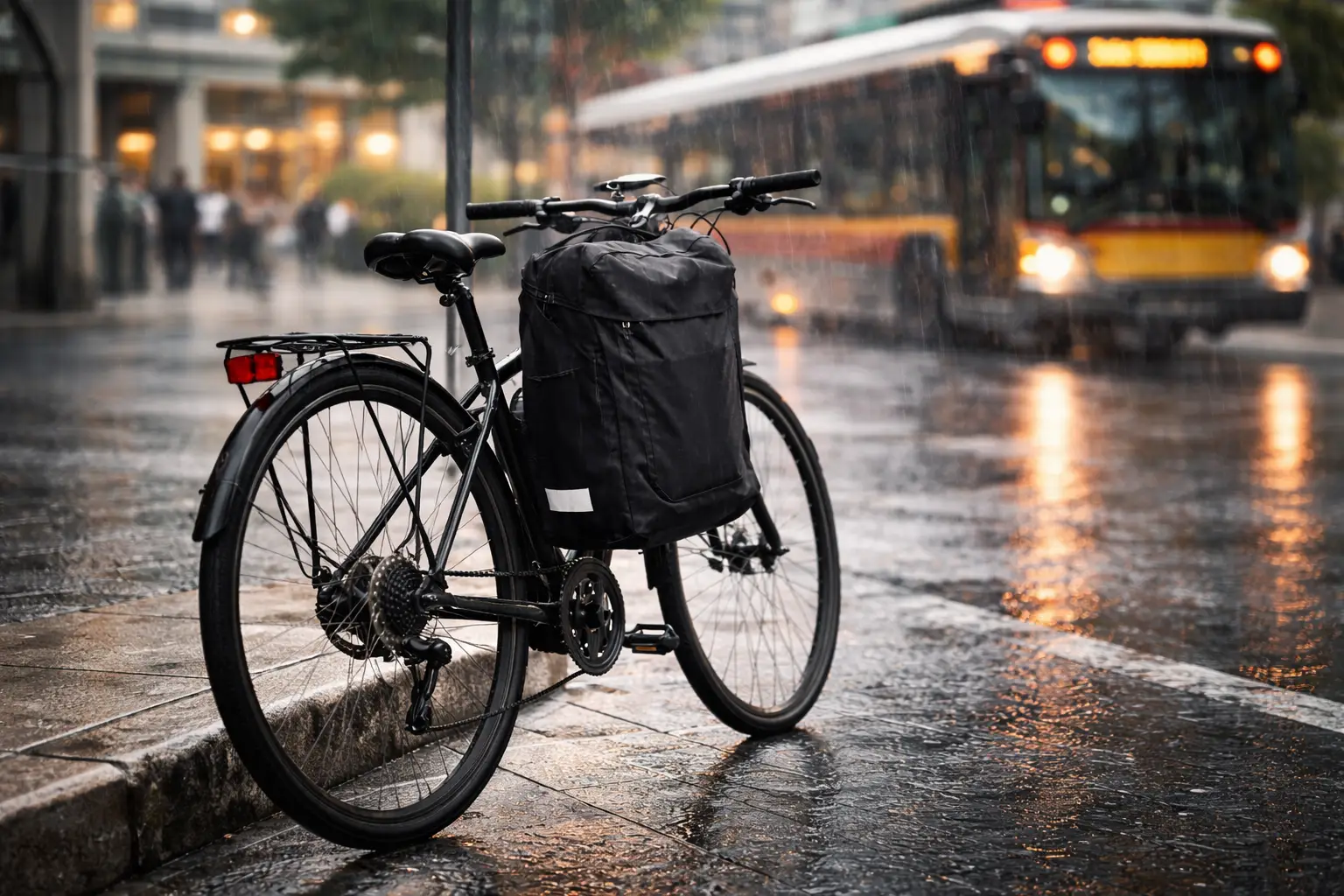
Real-world evaluation scene: a waterproof pannier on a commuter bike during heavy rain near public transit.
Real-World Commuting Scenarios Tested
To reflect realistic usage, commuter bicycle bags were evaluated across three primary urban scenarios:
Bag self-weight (g) and strength-to-weight efficiency
This methodology prioritizes safety and durability over purely cosmetic design.
2026 Urban Commuting Trends That Are Changing Bicycle Bags
From Capacity-Focused to Stability-Centered Design
In earlier years, commuting bags were marketed primarily by volume. In 2026, stability has overtaken capacity as the leading performance indicator. Field observations show that bags exceeding 20 L but lacking lateral control increase rider energy expenditure by up to 8% over a 10 km commute.
Lighter Materials, Higher Strength Ratios
Advanced woven synthetics now allow manufacturers to reduce bag weight by 15–25% while maintaining equivalent abrasion resistance. The use of 840D–900D reinforced fabrics has become more common, replacing heavier legacy materials without sacrificing durability.
Reflective Safety as a Regulatory-Driven Requirement
Urban cycling safety regulations increasingly emphasize visibility. Reflective surface coverage of 8–12% is becoming an informal baseline for commuter gear, particularly in European cities.
Compatibility With E-Bikes and Rear Racks
The growth of e-bikes has altered mounting geometry. Bags designed for traditional frames often fail under higher acceleration forces. In 2026, bicycle pannier bags for daily commuting must account for increased torque and vibration.
Best Backpack-Style Bicycle Bags for Daily Commuters
Backpack-style designs remain popular among riders who prioritize flexibility off the bike. In 2026, the best performers emphasize ventilation channels, stabilized shoulder load distribution, and reinforced base panels.
Ideal capacity typically falls between 18 L and 25 L, balancing laptop transport with manageable riding weight. For riders carrying electronics, bike bags for laptop commuting now integrate suspended compartments capable of reducing impact transmission by approximately 30% compared to flat-panel designs.
Best Pannier Bags for Urban Commuting
Pannier systems dominate longer and heavier commutes due to their superior load transfer. High-performing models in 2026 demonstrate sway angles under 5 degrees at 20 km/h, a critical threshold for rider balance.
Modern commuter bike bags waterproof in this category frequently support loads of 9–12 kg while maintaining consistent alignment on standard rear racks. Quick-release systems have also improved, reducing average mounting time to under 3 seconds.
Best Waterproof Bicycle Bags for Rainy Cities
Urban riders increasingly demand true waterproofing rather than water resistance. In practical terms, this translates to roll-top closures combined with welded seams.
Materials such as TPU-laminated fabrics outperform traditional PU coatings in repeated rain exposure. Bags achieving IPX4-equivalent performance show less than 5% internal moisture penetration after 30 minutes of sustained rainfall.
Best Bicycle Bags for Laptop and Office Gear
Office-oriented commuting places unique demands on internal structure. In 2026, high-quality commuting bags integrate rigid frames or semi-floating laptop sleeves that isolate electronics from road shock.
An effective design allows a 15-inch laptop to remain stable under loads exceeding 6 kg without contact with the bag’s outer shell.
Best Lightweight Commuter Bike Bags
Lightweight solutions cater to riders prioritizing agility. Bags under 900 g now commonly support loads of 5–7 kg due to improved fabric efficiency.
For urban riders covering shorter distances, urban cycling bags for work in this category minimize aerodynamic drag and simplify daily handling.
Materials & Engineering Behind High-Performance Commuter Bike Bags
Fabric Types and Denier Comparisons
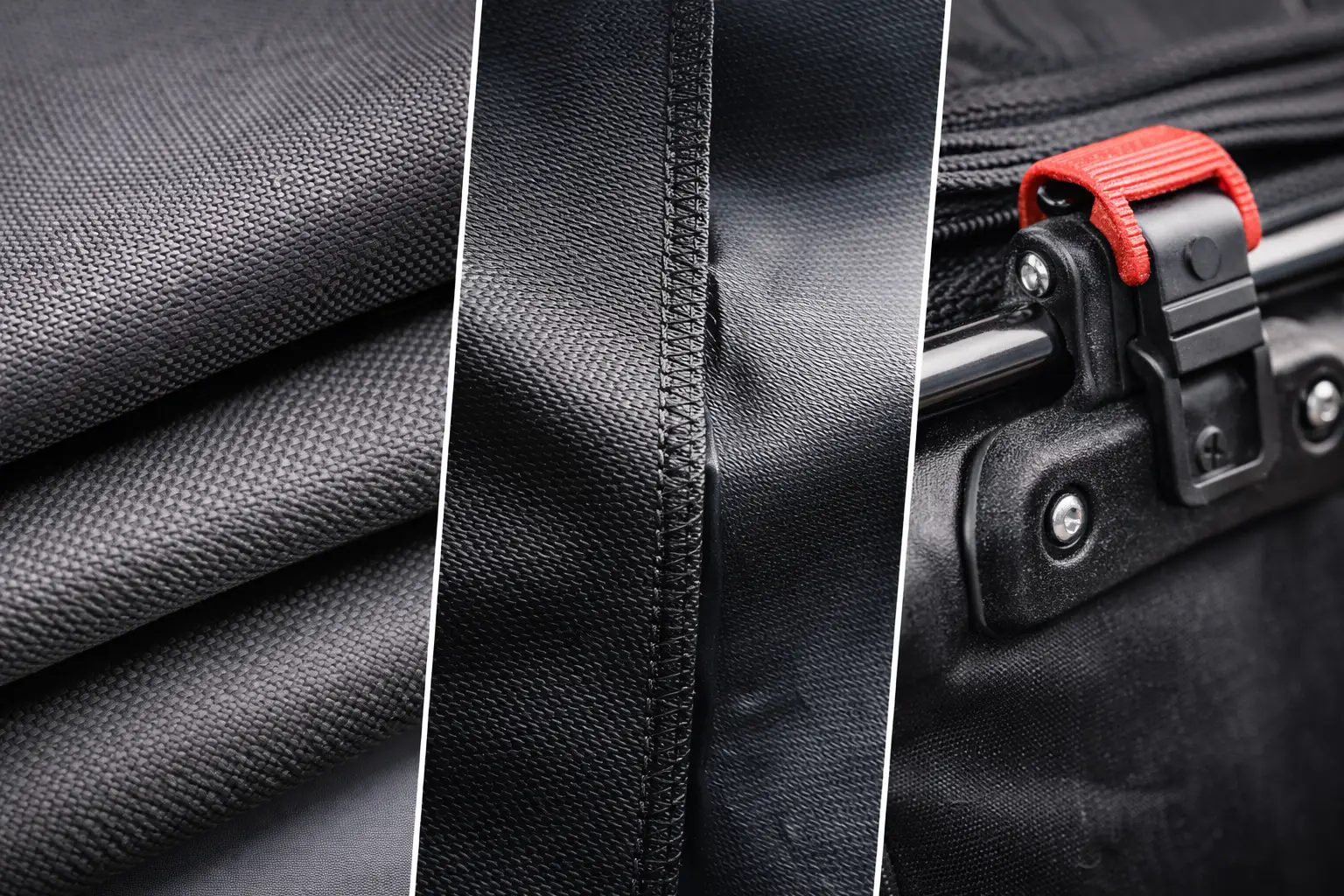
Engineering details that affect commuting performance: fabric weave, seam construction, and rack hook hardware.
900D reinforced nylon: high durability with controlled mass
1680D ballistic nylon: extreme abrasion resistance with weight penalty
For daily commuting, 840D–900D fabrics provide optimal longevity without unnecessary bulk.
Waterproof Coatings and Seam Technologies
Thermally welded seams reduce water ingress points by up to 90% compared to stitched constructions. TPU coatings maintain flexibility at lower temperatures, improving cold-weather performance.
Hardware Stress Points and Failure Analysis
Failure analysis consistently identifies hook deformation and rail fatigue as primary weak points. Reinforced glass-fiber polymer hooks demonstrate up to 40% higher fatigue resistance than basic ABS components.
Many cities now recommend minimum reflective coverage on moving accessories. Commuter bags exceeding 10% reflective surface demonstrate measurable improvements in nighttime recognition distance.
Load Safety and Mounting Stability Guidelines
Industry consensus increasingly discourages rear-mounted loads exceeding 25% of rider body weight. Proper distribution through pannier systems helps mitigate imbalance risks.
EU and US Urban Mobility Policy Trends
Policy initiatives promoting cycling infrastructure indirectly raise performance expectations for commuter gear. Durability, safety, and environmental impact are increasingly scrutinized.
Manufacturer & Factory Perspective: What Buyers Should Know
OEM vs Retail Designs for Commuting Bags
OEM-focused designs often prioritize structural integrity over visual branding. Buyers sourcing from a bicycle bag manufacturer or bicycle bag factory may find improved material consistency and quality control.
Wholesale and Customization Considerations
For bulk purchasing, commuter bike bag wholesale programs typically offer reinforced hardware options and tailored reflective layouts to meet regional safety preferences.
Lead Time, Quality Control, and Material Consistency
Stable sourcing of high-denier fabrics remains a challenge. Factories with controlled material pipelines achieve lower defect rates and longer product lifespans.
How to Choose the Right Commuter Bicycle Bag in 2026: A Scenario-Based Decision Framework
Choosing a commuter bicycle bag in 2026 is less about personal preference and more about aligning equipment with predictable urban variables. Instead of asking “Which bag looks best?”, experienced commuters now ask a different set of questions: how far is the ride, how heavy is the daily load, how often does weather interfere, and how stable does the bike remain under motion.
Distance is the first filter. For short urban rides under 8 km, lightweight designs reduce handling fatigue and make frequent mounting easier. Once daily commuting exceeds 10 km, especially on uneven city roads, load distribution becomes more important than total capacity. This is where rear-mounted systems begin to outperform body-carried solutions by keeping mass off the rider and closer to the bike’s centerline.
Load weight is the second decisive factor. Daily commuter loads typically fall between 4 kg and 9 kg, but how that weight behaves matters more than the number itself. Bags that allow internal movement amplify sway during braking and cornering, while structured compartments maintain predictable handling. In practice, stability under motion often matters more than adding an extra few liters of storage.
Weather exposure further narrows viable options. In cities where rain is frequent or unpredictable, water resistance is not sufficient. Riders should prioritize designs that manage prolonged exposure rather than brief splashes. This means evaluating closure systems, seam construction, and how water behaves at stress points after repeated use, not just during initial testing.
Finally, riders should consider future compatibility. The increasing presence of e-bikes changes acceleration forces and mounting stress, making reinforcement and attachment reliability critical. A commuter bag chosen in 2026 should not only fit today’s ride but remain stable as mobility patterns evolve.
Why Commuter Bicycle Bags Fail in Real Life: Design and Usage Mistakes
Most commuter bicycle bags do not fail because of extreme abuse. They fail quietly, through repeated daily use that exposes small design weaknesses over time. Understanding these failure patterns helps riders avoid choices that look adequate on paper but underperform in practice.
One of the most common mistakes is prioritizing capacity over stability. Larger bags often invite heavier loads, which in turn increase lateral movement. Even small increases in sway force riders to make constant micro-adjustments, increasing fatigue and reducing control in traffic. Over weeks and months, this instability becomes more noticeable than any storage benefit.
Another overlooked issue is hardware fatigue. Hooks, rails, and attachment points experience repeated stress during mounting and riding. Designs that rely on basic plastics or minimally reinforced components may perform well initially but degrade after hundreds of cycles. Once deformation begins, stability declines rapidly, even if the fabric remains intact.
Water protection is also frequently misunderstood. Many commuters assume that coated fabrics alone guarantee waterproof performance. In reality, water intrusion most often occurs at seams, corners, and closure interfaces. Bags that rely heavily on stitched construction without reinforcement are far more likely to fail during extended rain exposure.
Visibility-related mistakes carry safety implications. Decorative reflective accents may look sufficient in product photos but provide limited real-world benefit. In urban traffic, reflective placement and coverage determine how early a rider is recognized by approaching vehicles, particularly from oblique angles at night.
Finally, commuters often underestimate how usage patterns change. A bag that works for occasional rides may not withstand daily mounting, carrying through stations, or exposure to crowded environments. Durability must be evaluated as a function of repetition, not just material thickness.
Final Insight: Why the Right Commuter Bicycle Bag Defines Daily Efficiency in 2026
In 2026, commuter bicycle bags are no longer judged by how much they can carry, but by how reliably they integrate into daily life. Efficiency, in this context, means predictability—knowing that a bag will remain stable, keep contents dry, and maintain visibility without demanding constant attention from the rider.
Urban commuting has become more structured and repetitive, which magnifies small inefficiencies. A bag that shifts slightly, leaks occasionally, or wears prematurely introduces friction into a routine that depends on consistency. Over time, these small issues affect comfort, safety, and even punctuality.
The most effective commuter bags are those designed around real urban constraints: limited space, variable weather, mixed transport modes, and evolving mobility infrastructure. They support the rider rather than compete for attention, allowing focus to remain on traffic, timing, and destination.
As cities continue to encourage cycling as a primary transport option, equipment expectations will rise accordingly. Choosing the right commuter bicycle bag in 2026 is therefore not a lifestyle decision but an operational one—an investment in smoother, safer, and more efficient daily movement.
FAQs
1. What is the best bicycle bag for daily commuting in 2026?
The best option depends on distance and load, but most urban commuters benefit from stable pannier systems or structured backpacks designed specifically for daily use.
2. Are pannier bags better than backpacks for urban commuting?
Pannier bags generally offer better load distribution and reduced rider fatigue, especially for commutes over 10 km.
3. How waterproof should a commuting bicycle bag be?
For daily commuting, IPX4-equivalent protection is recommended to handle sustained rain without internal moisture intrusion.
4. Can commuter bike bags safely carry laptops?
Yes, provided the bag includes suspended or reinforced laptop compartments that reduce vibration and impact transfer.
5. Are bicycle bags compatible with e-bikes?
Most modern designs are compatible, but riders should ensure mounting systems are rated for higher acceleration forces.
Commuter Bicycle Bag Insights for 2026
What is “best” in 2026, really?
“Best” no longer means the biggest capacity. In 2026, commuters judge bags by the ability to stay stable under real movement—stop-and-go intersections, curb drops, tight turns, and fast e-bike acceleration. A commuter bag that reduces sway, keeps weight centered, and stays predictable under 6–12 kg loads tends to outperform larger but unstable designs—even when the capacity looks impressive on paper.
Why stability beats volume for daily riders
The commuting pattern is repetitive: you mount, ride, brake, walk, remount, repeat—often hundreds of cycles per month. When a bag shifts laterally, it creates continuous micro-corrections that increase fatigue and reduce control in traffic. That’s why **bicycle pannier bags for daily commuting** and structured commuter backpacks are trending: they improve “handling confidence,” not just storage.
How waterproof claims translate into commuter reality
For city riders, “water-resistant” usually means “fine for splashes,” not sustained rain. In rainy cities, the practical target is roll-top geometry and seam strategies that keep moisture out during 20–40 minutes of continuous rainfall—especially around zipper tracks and stitched corners. Buyers searching **commuter bike bags waterproof** should treat seam construction as seriously as fabric coating, because most leaks occur at junctions, not on flat panels.
What to look for in fabric denier and construction
Denier alone doesn’t guarantee durability, but it offers a useful baseline. Many 2026 commuter designs balance weight and abrasion resistance in the 840D–900D range, while “ultra heavy” fabrics can add unnecessary mass for short commutes. A smarter signal is the combination: denier + weave density + reinforcement zones at the base and hook points—where daily wear concentrates.
Option mapping: which commuter profile fits which bag type
If you carry a laptop and need off-bike comfort, prioritize **bike bags for laptop commuting** with suspended protection and a firm back panel. If your ride is 10–18 km or you carry heavier gear, panniers reduce shoulder load and improve balance. If you switch between bike and metro, choose designs that can transition quickly—stable on the rack, comfortable in-hand, and not awkward in tight stations. For office-first riders, **urban cycling bags for work** should emphasize quick access, clean organization, and a predictable silhouette that doesn’t snag in crowds.
Considerations that buyers and sourcing teams miss
Many product pages talk about “waterproof” and “large capacity,” but daily commuting failures often come from hardware fatigue, hook deformation, and rail wear after repeated mounting. If you’re sourcing from a **bicycle bag manufacturer** or evaluating a **bicycle bag factory**, ask about cycle testing, hook material (reinforced polymer vs basic plastic), and consistency of reinforcement stitching. For B2B buyers considering **commuter bike bag wholesale**, stability hardware and reflective layout are typically higher ROI than adding a few liters of volume.
2026 trend signal: visibility and compliance are becoming non-negotiable
Cities are pushing safer micro-mobility, and visibility expectations are rising with it. Reflective placement that works at multiple angles—rear approach, side crossing, and low-light street reflection—matters more than a single reflective stripe. In practice, commuter bags that integrate meaningful reflective coverage (not just decorative hits) are more likely to meet evolving urban safety norms and earn stronger buyer trust over time.