Backpack Size for Ryanair in 2026: Exact Rules, Real Fit Tests & Boarding Risk Analysis
2026-02-28
Quick Summary: Ryanair allows one free personal item (40 × 30 × 20 cm) that must fit under the seat, and a larger cabin bag (55 × 40 × 20 cm) with Priority boarding. A 40L backpack usually exceeds the free allowance unless significantly compressed. Gate checks are triggered by visual size and fit in the sizer frame. The safest approach is choosing a soft, rectangular backpack with strong compression straps, keeping packed depth under 20 cm, and avoiding rigid frame systems.
Quick Answer: What Size Backpack Does Ryanair Actually Allow?
As of 2026, Ryanair allows:
One free personal item: 40 × 20 × 25 cm
Priority cabin bag: 55 × 40 × 20 cm
The free item must fit under the seat in front of you. If your backpack exceeds the limit at the boarding gate, you may be charged a fee and forced to check it in.
That’s the official rule.
But the real question most travelers ask isn’t about the numbers.
It’s this:
Will my backpack actually pass at the gate?
That’s what we’ll break down in detail.
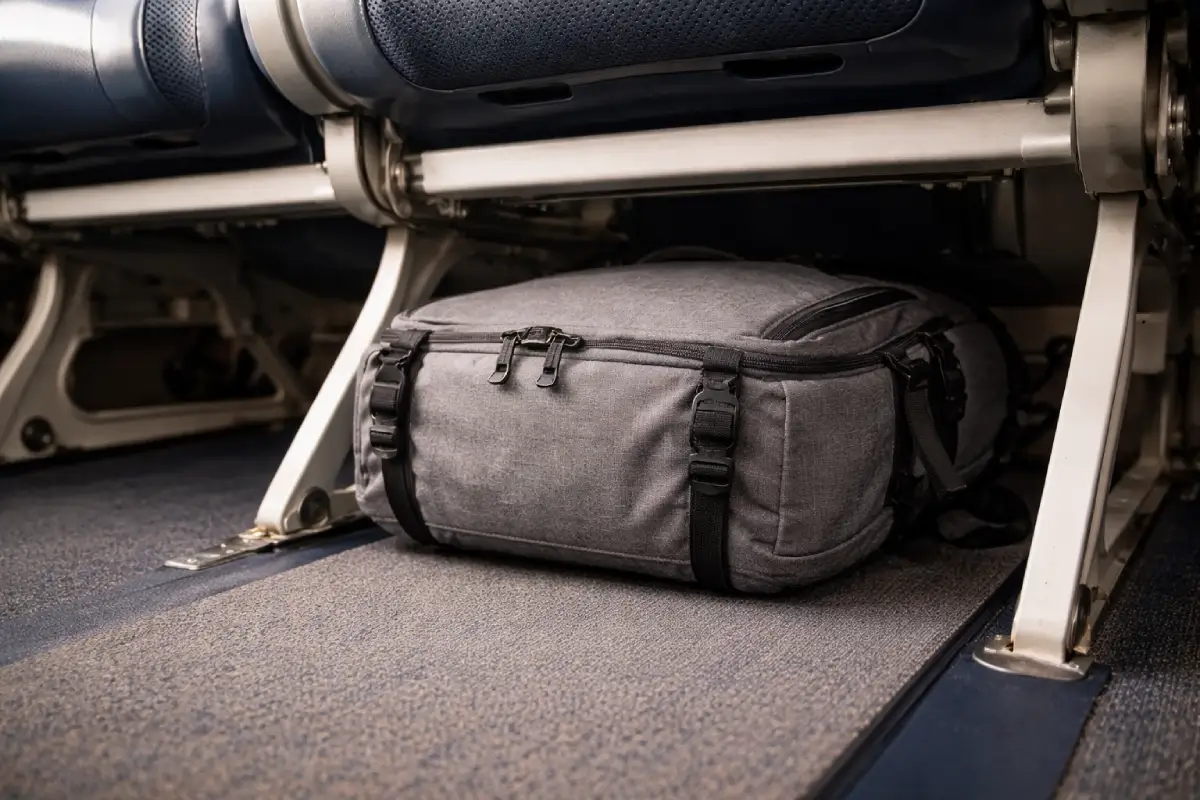
Example of a cabin-compliant backpack fitting under a Ryanair seat.
What Do the Official Dimensions Really Mean in Practice?
If your bag looks borderline, staff may ask you to place it into a metal sizer frame.
If it does not slide in smoothly, you may be charged.
What Happens If Your Backpack Is Too Big?
At the gate, you typically face two outcomes:
Forced check-in at a higher fee than pre-booking
Delay while processing payment
This is why many frequent travelers either:
Pre-purchase Priority
Or carry a clearly compliant compact backpack
The cost difference can often exceed the price difference between two backpack models.
How to Choose a Backpack That Safely Passes Ryanair Gate Checks
Knowing the official size is only half the story. What truly determines whether your backpack passes inspection is structure, compression behavior, and visual profile.
If your goal is zero boarding risk, focus on these factors.
1. Shape and Depth Matter More Than Capacity
Ryanair’s most restrictive measurement is depth.
A 25L backpack that bulges outward can fail, while a well-compressed 30L travel pack may pass.
The safest backpack profile typically includes:
Flat rectangular silhouette
Minimal exterior pockets
No rigid back frame
Strong side compression straps
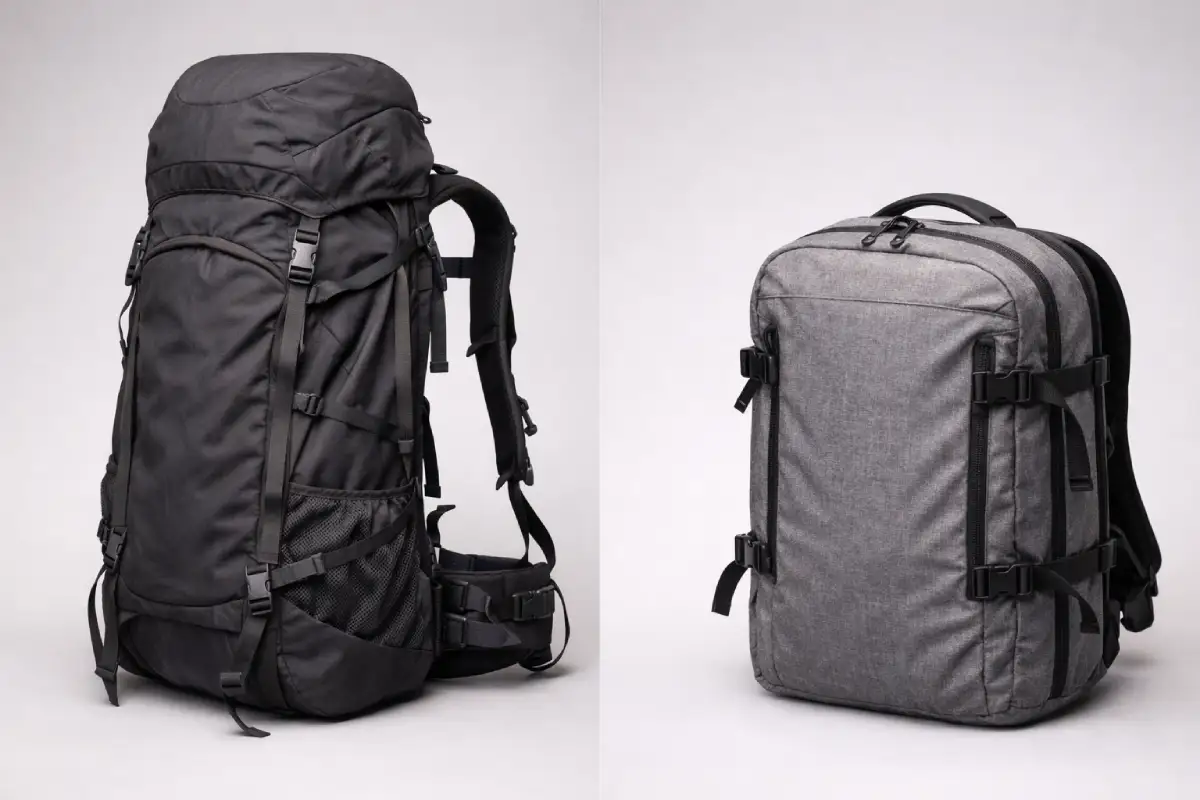
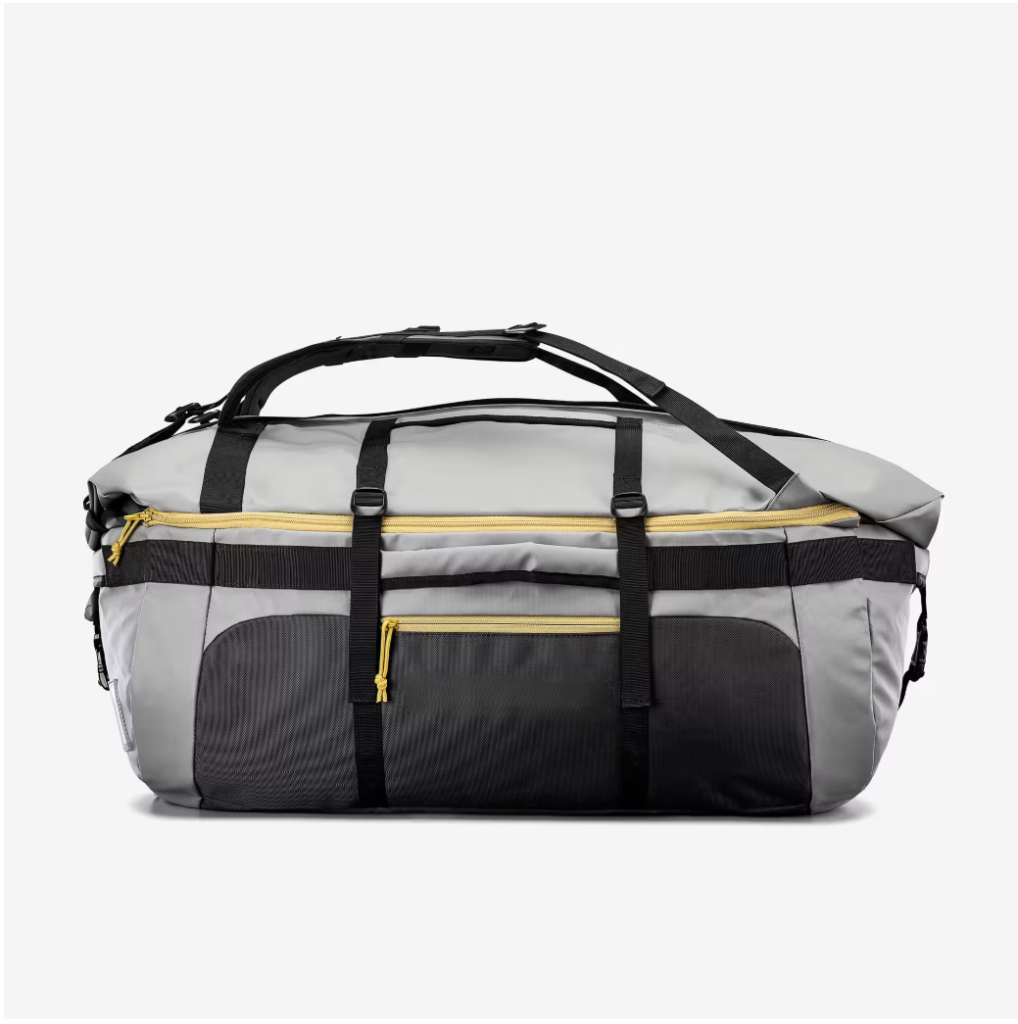
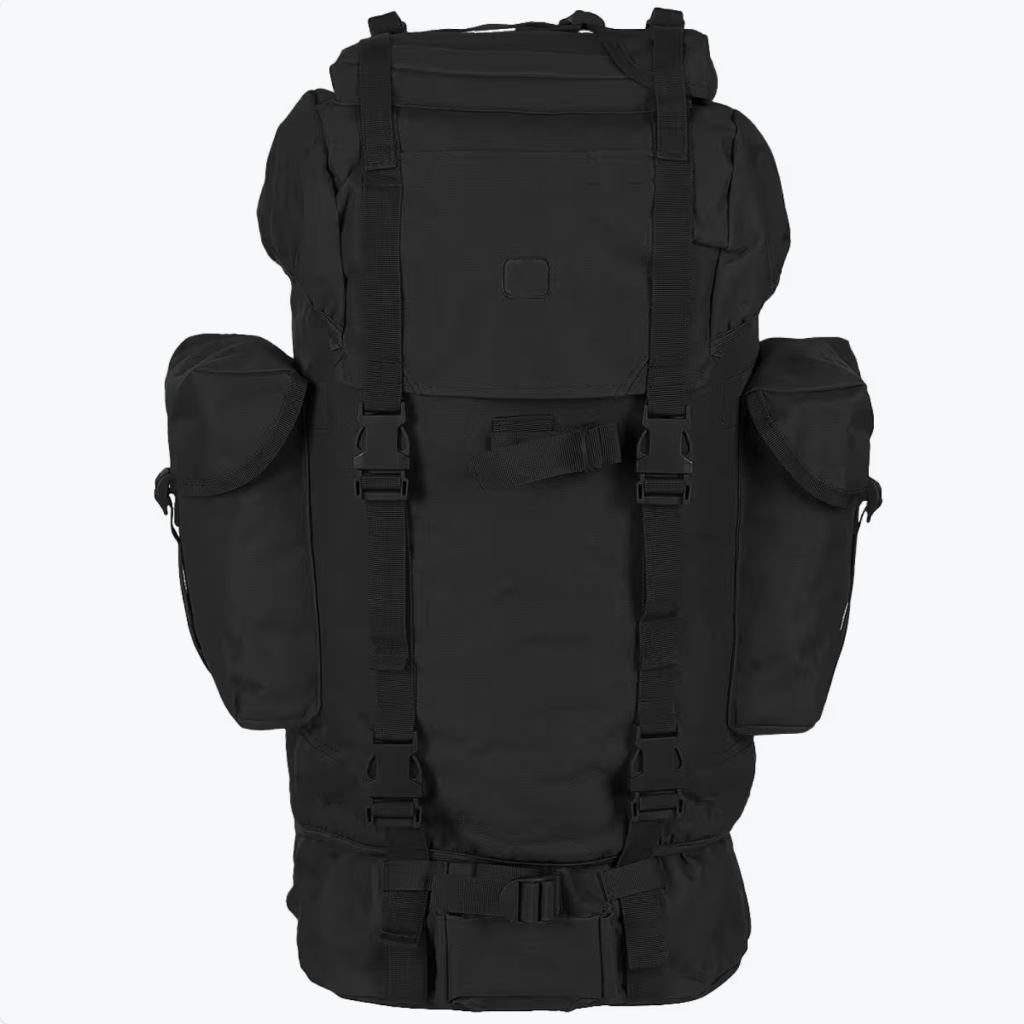
Traditional hiking backpacks often fail not because of volume, but because of curved frame systems and extended height.
2. Travel Packs Are Safer Than Technical Hiking Packs
Many hiking backpacks are engineered for airflow and trail ergonomics. That design includes:
Aluminum or composite frame stays
Raised mesh back panels
Tall top-loading design
These features reduce compressibility.
Urban-style travel backpacks, by contrast, tend to:
Sit flat against the back
Maintain consistent thickness
Compress easily when tightened
For airline compliance, structure flexibility is more important than ventilation systems.
Experienced travelers often pack slightly below maximum capacity to prevent outward bulging during long walks through the airport.
Compression is not optional — it is your insurance policy.
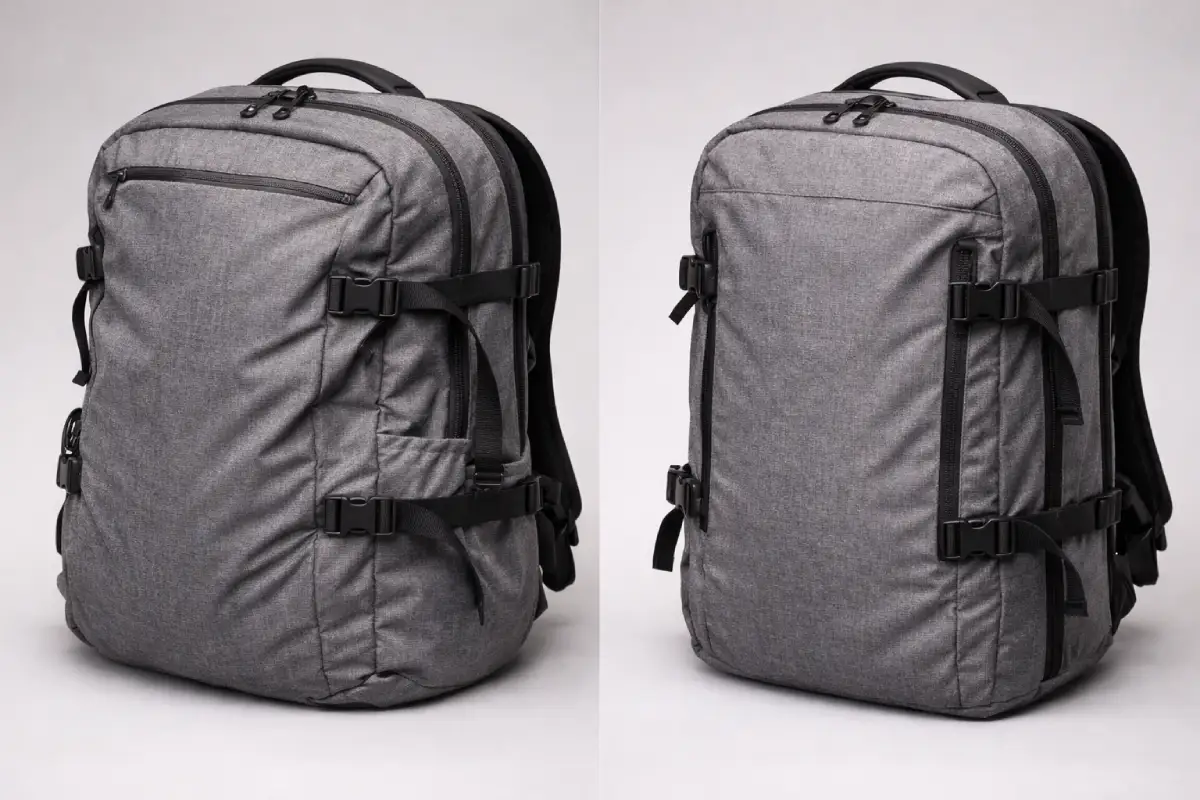
Side-by-side comparison of a travel backpack before and after compression. The uncompressed version appears bulky and expanded, while the compressed version shows a flatter, streamlined profile suitable for airline cabin size limits.
Real Travel Scenarios: What Actually Works on Ryanair
Scenario 1: Weekend Trip (2–3 Days)
Best approach:
20–25L soft-shell backpack
No external attachments
Shoes worn, not packed
This configuration almost never triggers inspection and easily fits under-seat dimensions.
Scenario 2: 5–7 Day European Trip
If flying with Priority:
30–40L rectangular travel backpack
Packed to roughly 80% capacity
Fully tightened compression system
If relying only on the free personal item:
Lightweight clothing strategy
Mid-trip laundry
No heavy footwear packed
This is where many travelers miscalculate space requirements.
Scenario 3: Multi-Airline Budget Travel
If you’re flying multiple low-cost carriers:
Choose the strictest airline limit as your baseline
Avoid expandable zip systems
Avoid detachable add-ons or hanging gear
Consistency reduces stress and repacking at every airport.
The Most Common Mistakes Travelers Make
Even frequent flyers repeat these errors.
Mistake 1: Thinking Liters Equal Compliance
Backpack volume is marketing language. Airlines measure external dimensions only.
Mistake 2: Testing Fit Without Real-World Compression
A bag that “barely fits” at home often expands after walking through terminals.
Always test after full packing and strap tightening.
Mistake 3: Ignoring Visual Size Perception
Gate staff often assess by appearance first.
If your backpack looks oversized, even if technically within limits, you are more likely to be stopped.
Low-profile design reduces inspection risk.
Mistake 4: Choosing Hiking Packs for Urban Air Travel
Ventilated hiking systems are optimized for trail comfort — not for airline sizer frames.
Urban travel backpacks are more predictable in compliance.
Is a Backpack Better Than a Suitcase for Ryanair?
In most cases, yes.
Backpacks offer:
Greater compression flexibility
Easier under-seat adaptation
Faster boarding
Better mobility through tight cabin aisles
Hard-shell suitcases cannot compress. If slightly oversized, they automatically fail measurement.
Soft backpacks provide adjustment margin.
Risk-Free Ryanair Packing Checklist
To minimize boarding stress:
Keep packed depth under 20 cm
Avoid rigid internal frame systems
Tighten all compression straps before boarding
Do not overload front pockets
Pre-book Priority if borderline
These steps dramatically reduce the likelihood of gate fees.
Frequently Asked Questions
1. Will Ryanair measure my backpack at the boarding gate?
Yes, Ryanair does measure backpacks at the gate, although not every passenger is checked. Measurement usually happens when a bag looks oversized or when the flight is very full. Gate staff often perform a quick visual assessment first. If your backpack appears thick, rigid, or unusually tall, you may be asked to place it inside a metal sizer frame. The key factor is whether the bag slides into the frame naturally without force. If it does not fit smoothly, you may be required to pay a last-minute handling fee and check the bag into the aircraft hold. Travelers carrying compact, well-compressed backpacks rarely face issues. The safest approach is to assume that inspection is possible on every flight and pack accordingly rather than relying on luck or staff leniency.
2. Can a 40L backpack fit within Ryanair’s free personal item allowance?
In most realistic packing scenarios, a 40L backpack exceeds the free personal item limit of 40 × 20 × 25 cm. Even if the listed capacity seems close, volume measurements do not directly translate to external dimensions. A 40L backpack typically becomes too thick once clothing, shoes, or electronics are packed inside. Some soft travel backpacks labeled as 40L can compress close to cabin bag dimensions if not fully packed, but they almost never comply with the smaller free allowance. If you plan to travel with a 40L backpack, purchasing Priority boarding is generally the safer and more predictable choice. Attempting to pass it as a personal item carries a measurable risk of inspection and additional charges at the gate.
3. How strict is Ryanair compared to other European airlines regarding backpack size?
Ryanair is widely recognized as one of the stricter low-cost carriers when it comes to baggage enforcement. Unlike some airlines that occasionally overlook small deviations, Ryanair frequently conducts visual checks and spot measurements. Because baggage fees represent a meaningful portion of ancillary revenue, enforcement is often consistent, particularly on busy routes and peak travel seasons. However, strict does not mean unpredictable. Most inspections are triggered by visible size concerns rather than random selection. A low-profile backpack that clearly fits under the seat is unlikely to be challenged. Problems typically arise when bags appear oversized, heavily packed, or structurally rigid. Understanding this pattern helps travelers make informed packing decisions.
4. What happens if my backpack is slightly too large at the gate?
If your backpack does not fit inside the measurement frame when requested, you will usually be required to pay a gate handling fee. This fee is often higher than the cost of purchasing cabin baggage in advance. After payment, the bag is typically tagged and placed in the aircraft hold. This process can delay boarding and create unnecessary stress, especially if payment must be made quickly. Even a few extra centimeters in depth can cause failure if the bag cannot enter the sizer frame smoothly. For this reason, travelers are advised to pack conservatively and tighten compression straps before approaching the boarding area rather than trying to adjust at the last moment.
5. Does wearing the backpack during boarding reduce the chance of inspection?
No, wearing your backpack does not exempt it from inspection. Gate staff may still ask you to remove the bag and place it in the sizer frame if it appears oversized. In fact, large backpacks worn high on the shoulders can draw more attention because they visually extend above the back and look bulkier. Airlines focus on compliance with dimension limits, not on how the bag is carried. The most reliable strategy is not concealment but structural compatibility. Choosing a backpack with a compact profile and ensuring it is properly compressed significantly reduces inspection risk.
6. Is a soft backpack safer than a hard suitcase for Ryanair flights?
Generally, a soft backpack provides more flexibility than a hard-shell suitcase. Soft materials allow slight compression, which can make the difference between passing and failing a sizer test. Hard suitcases cannot adapt if slightly oversized, making them more vulnerable to strict enforcement. However, not all backpacks are equally flexible. Technical hiking packs with internal frames or rigid support panels behave more like structured luggage and resist compression. Urban travel backpacks with minimal internal framing and strong side straps tend to perform better under airline restrictions. The advantage lies in adaptability rather than simply choosing a backpack over a suitcase.
7. Can I slightly overpack and compress the backpack at the gate?
Relying on last-minute compression is risky. Backpacks often expand during transit due to movement, shifting contents, and walking through terminals. A bag that appears compliant at home may bulge after being carried for several hours. Additionally, adjusting straps hurriedly near the boarding area can attract attention from staff monitoring bag size. The safer approach is to compress fully before reaching the gate and ensure the bag maintains a stable, flat profile. Packing slightly below maximum capacity gives you a margin of safety and reduces stress during boarding.
8. What type of backpack design carries the lowest inspection risk?
Backpacks with a rectangular silhouette, soft construction, and effective compression straps generally carry the lowest inspection risk. Avoid tall top-loading hiking packs, external attachments, rigid frame systems, and extended side pockets. A clean, compact design that sits flat against the back signals compliance visually. Airlines often rely on visual cues before deciding whether to measure. A backpack that looks modest in size is less likely to be challenged than one that appears bulky or heavily loaded. Choosing a design optimized for travel rather than technical trekking improves predictability during boarding.
Final Verdict
Ryanair’s backpack rules are strict, but they are consistent.
Travelers who focus on:
External dimensions
Compression behavior
Visual profile
Boarding dynamics
can avoid unnecessary fees and travel with confidence.
Smart compliance is not about buying the smallest bag — it’s about choosing the right structure and packing intelligently.
References
Ryanair DAC Ryanair’s Bag Policy Ryanair Official Help Centre https://help.ryanair.com/hc/en-us/articles/12888036565521-Ryanair-s-Bag-Policy
Ryanair DAC Bag Sizers and Gate Bag Fees Explained Ryanair Official Website https://www.ryanair.com/us/en/lp/travel-extras/bag-sizers-and-gate-bag-fees-explained
European Commission – Mobility and Transport Air Passenger Rights – Your Europe Portal European Union Official Portal https://europa.eu/youreurope/citizens/travel/passenger-rights/air/index_en.htm
UK Civil Aviation Authority (CAA) Baggage and Airline Policies – Passenger Guidance Civil Aviation Authority (United Kingdom) https://www.caa.co.uk/passengers/before-you-fly/baggage/
Airline Compliance Insight: How Backpack Structure, Packing Strategy, and Policy Trends Intersect
How do airline backpack rules actually work in practice?
Airline baggage compliance is not only about listed dimensions. It is a combination of official measurement limits, real-world sizer frame testing, visual inspection logic, and cabin space constraints. Ryanair’s model prioritizes under-seat optimization and ancillary revenue control, which explains why depth and compressibility matter more than advertised volume.
Why does backpack structure matter more than capacity?
Capacity (liters) is a marketing metric, while airlines evaluate external dimensions. Backpacks with rigid frames, ventilation systems, or expanded front pockets are structurally resistant to compression. Soft-shell, rectangular travel packs offer adaptive fit, which reduces boarding risk under strict enforcement environments.
What options exist for different traveler types?
Minimalist weekend travelers can safely use compact 20–25L profiles. Multi-day travelers should evaluate Priority cabin allowances and choose 30–40L travel-oriented designs that compress below 20 cm depth. Frequent budget flyers benefit from selecting one universal backpack that meets the strictest airline standard across Europe.
What should travelers consider before boarding?
Consider visual profile, compression integrity, under-seat fit tolerance, and gate enforcement patterns. Slight overpacking increases inspection probability. Pre-tightened compression straps and low-profile silhouettes reduce measurement likelihood.
Market and regulatory trend outlook:
Across European low-cost carriers, enforcement consistency is increasing as airlines standardize ancillary revenue models. Travelers should expect continued scrutiny on cabin size compliance. Adaptive backpack design, modular compression systems, and airline-specific fit optimization are becoming defining product features in the travel gear market.
Strategic takeaway:
Choosing the right backpack for Ryanair is less about finding the smallest volume and more about selecting a structurally compliant, compressible design that aligns with airline enforcement logic. Smart compliance minimizes fees, speeds boarding, and enhances travel efficiency across multiple budget carriers.