Rezime rapid:
Choosing the right backpack size for winter travel depends on climate severity, clothing bulk, and trip duration. A 40L backpack can work for mild winter trips with disciplined layering, while a 50L backpack provides necessary margin for cold-weather destinations, heavy insulation, or snow-based travel. Winter travel increases packing volume by up to 50% compared to summer, making capacity planning essential.
Winter travel reshapes how your gear performs, not just what you pack. Temperature swings between heated interiors and freezing streets, bulkier footwear, and layered clothing systems all change how space is used inside a backpack. Capacity in winter behaves differently than it does in summer.
Cold-weather garments are structured around insulation, not compactness. Down jackets trap air. Wool layers retain thickness even when compressed. Winter boots occupy fixed, non-flexible volume. What fits comfortably in a 40L backpack during warm seasons may feel unexpectedly tight once thermal layers and heavier fabrics enter the equation.
For most travelers, the real winter decision is not about choosing “bigger or smaller.” It is about deciding whether disciplined packing within 40L aligns with your climate and itinerary, or whether upgrading to 50L provides the margin needed for insulation, footwear, and movement frequency. Climate intensity, trip duration, and travel rhythm ultimately determine which capacity supports the journey more effectively.
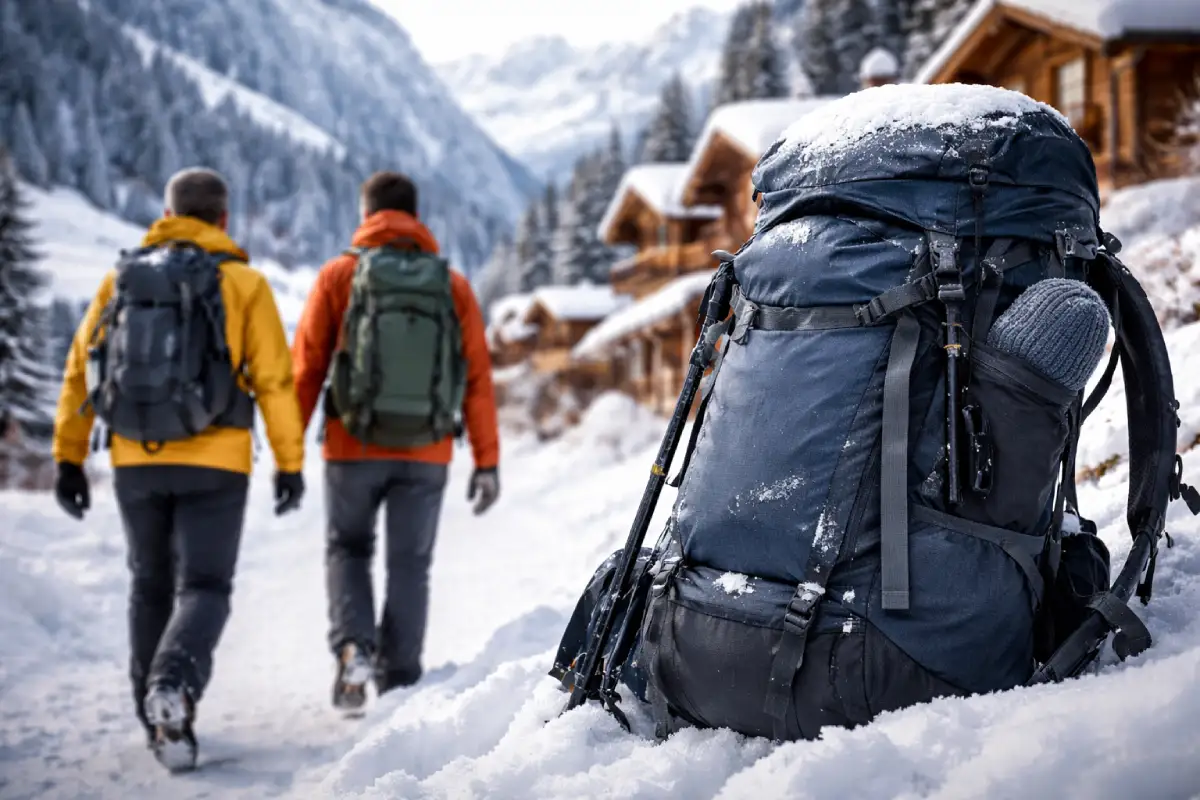
Why Winter Travel Requires a Different Backpack Size Strategy
In summer, clothing compresses easily. T-shirts, lightweight pants, and minimal footwear allow high packing efficiency. Winter gear behaves differently because insulation traps air — and air takes space.
Even when compressed, items like:
-
Down jackets
-
Thick sweaters
-
Thermal base layers
-
Waterproof outer shells
-
Winter boots
consume significantly more volume than their warm-weather equivalents.
The issue is not weight alone — it is bulk.
A winter travel backpack must accommodate three types of volume increase:
-
Layering expansion
-
Footwear bulk
-
Weather unpredictability
This is why backpack size for winter travel cannot be calculated using the same logic as a 7-day summer trip.
The Volume Reality of Winter Clothing
To understand what size backpack you need, it helps to understand how winter clothing scales in volume.
A single insulated jacket can occupy the space of three lightweight tops. Winter boots can take up as much space as two pairs of sneakers. Even accessories — scarves, gloves, hats — accumulate quickly.
Pou egzanp:
A typical 40L backpack that comfortably fits 6–7 summer outfits may realistically fit only:
-
3–4 winter outfits
-
One insulated jacket
-
One pair of boots
-
Basic toiletries
And that is before adding electronics or travel documents.
Winter travel compresses usable space faster than travelers expect.
Is 40L Enough for Winter Travel?
The short answer: sometimes.
A 40L backpack can work for winter travel under specific conditions:
-
Mild winter climates (Southern Europe, parts of Western Europe)
-
Trips under 5–7 days
-
Access to laundry
-
Layering strategy instead of heavy standalone coats
-
Limited footwear
If you rely on a compact insulation layer combined with a lightweight shell, rather than a bulky parka, 40L remains viable. Urban winter trips — where you are not carrying outdoor gear — often fit within this range.
The advantage of staying within 40L is mobility. Winter destinations frequently involve public transport, train transfers, or airport navigation. A slightly smaller bag improves balance and reduces fatigue in icy or crowded environments.
However, once temperatures drop significantly below freezing, space pressure increases quickly.
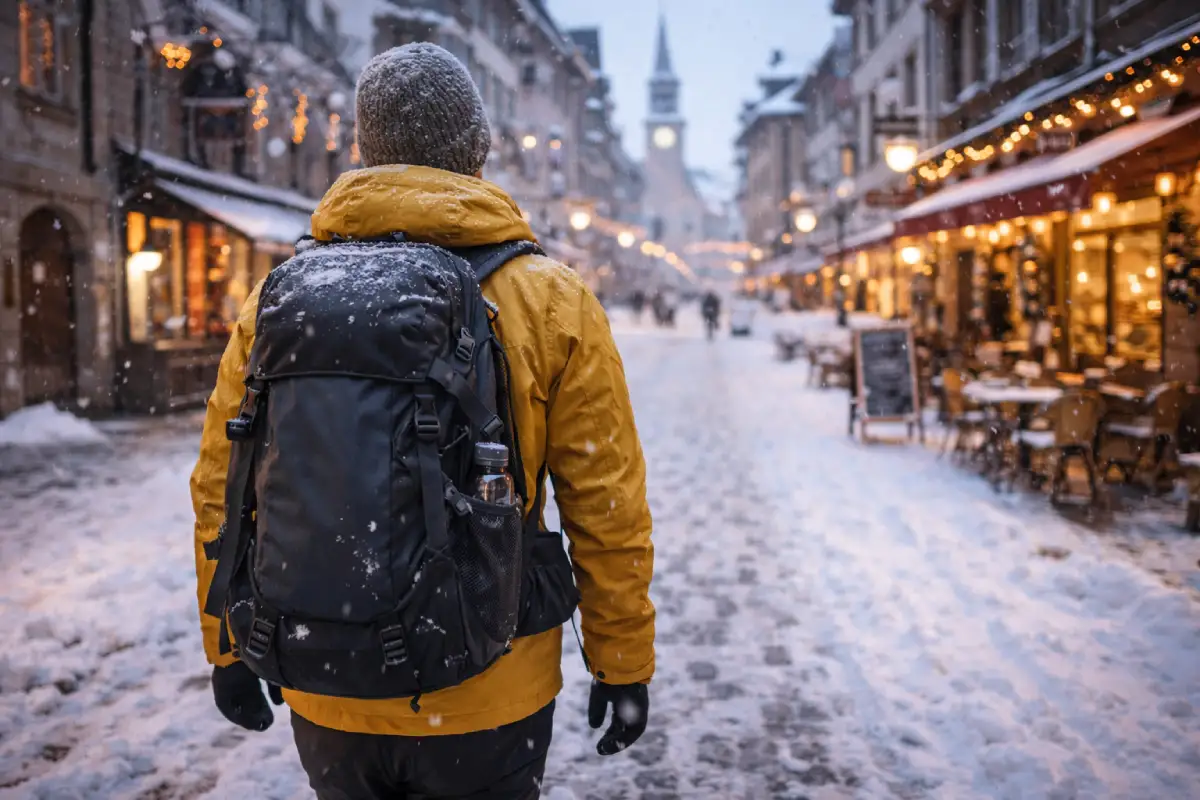
When 40L Begins to Feel Tight
There are clear signals that 40L may be insufficient for winter travel:
-
Heavy parka instead of compressible down jacket
-
Thick wool sweaters
-
Insulated snow boots
-
Camera gear for winter landscapes
-
Multi-layer thermal systems
In these scenarios, compression becomes excessive. Over-packing reduces flexibility and makes it harder to access essentials during transit.
Winter travel already increases physical strain. An overstuffed 40L pack can feel denser and less forgiving in narrow streets or on slippery sidewalks.
When comfort becomes secondary to compression, upgrading capacity may improve overall travel experience.
When 50L Makes Practical Sense in Winter
A 50L backpack becomes appropriate when winter travel includes:
-
Sub-zero climates (Nordic countries, alpine regions)
-
Outdoor or snow-based activities
-
Trips longer than 7–10 days without laundry
-
Gear-intensive itineraries
The additional 10 liters does not merely add volume; it adds margin. That margin allows clothing to sit naturally instead of being aggressively compressed.
It also improves packing organization. Winter layering systems often include base layers, mid-layers, and outer shells. Having dedicated compartments or additional internal space reduces packing friction.
That said, 50L introduces trade-offs.
Larger backpacks:
Winter backpack size is always a balance between environmental demands and movement efficiency.
Winter Travel and Airline Carry-On Limitations
Many travelers aim to avoid checked baggage fees, even in winter. This creates tension between capacity and compliance.
Most airline cabin limits remain consistent year-round. Winter does not increase allowed dimensions.
A fully packed 50L backpack may exceed depth restrictions, especially if rigid or overfilled. Soft-shell 40L backpacks often perform better under strict cabin enforcement.
A common winter strategy is to wear the bulkiest clothing during travel:
This reduces internal volume pressure and keeps 40L more realistic.
Winter packing is as much about distribution as size.
Mobility Matters More in Winter
Winter travel often includes:
Carrying an oversized pack in these environments increases fatigue and reduces balance.
While 50L provides comfort in packing, 40L improves mobility. The correct choice depends on whether your winter trip emphasizes outdoor exposure or urban exploration.
Urban winter travel favors mobility.
Outdoor winter travel favors capacity.
Understanding which category your trip falls into is essential before choosing backpack size.
Winter Travel Is About Margin, Not Maximum
The core decision in winter travel is not “how big can I go?” It is “how much margin do I need?”
If your itinerary includes city transfers, train rides, and indoor attractions, a controlled 40L system may be sufficient.
If your trip includes snow activities, remote regions, or extended stays, the margin of 50L prevents frustration.
Backpack size for winter travel should reflect:
-
Climate severity
-
Clothing system
-
Trip duration
-
Movement frequency
Not simply fear of running out of space.
Winter Packing Strategy: Making 40L Work (If You Choose It)
If you decide to stay within 40L for winter travel, packing discipline becomes essential. The goal is not to reduce warmth — it is to reduce redundancy.
Prioritize Layer Systems Over Single Heavy Pieces
Instead of packing one thick parka plus multiple sweaters, consider a structured layering system:
Layering distributes insulation across multiple thinner garments, which pack more efficiently than one oversized coat.
Wear the Bulkiest Items in Transit
One of the simplest winter travel strategies is wearing your heaviest clothing while moving between locations.
Airports, trains, and buses are heated environments. Wearing boots and outerwear reduces internal backpack pressure and keeps volume under control.
Winter boots occupy substantial space. If possible:
Packing multiple bulky shoes quickly overwhelms a 40L backpack.
Compress Strategically, Not Aggressively
Compression sacks reduce volume, but over-compressing winter clothing makes backpacks rigid and less flexible in overhead bins.
The objective is organization and moderate compression — not maximum density.
When these strategies are applied carefully, 40L remains realistic for mild-to-moderate winter travel.
40L vs 50L in Winter: The Real Difference
The difference between 40L and 50L in winter is not simply “10 liters more.”
It changes how you experience your trip.
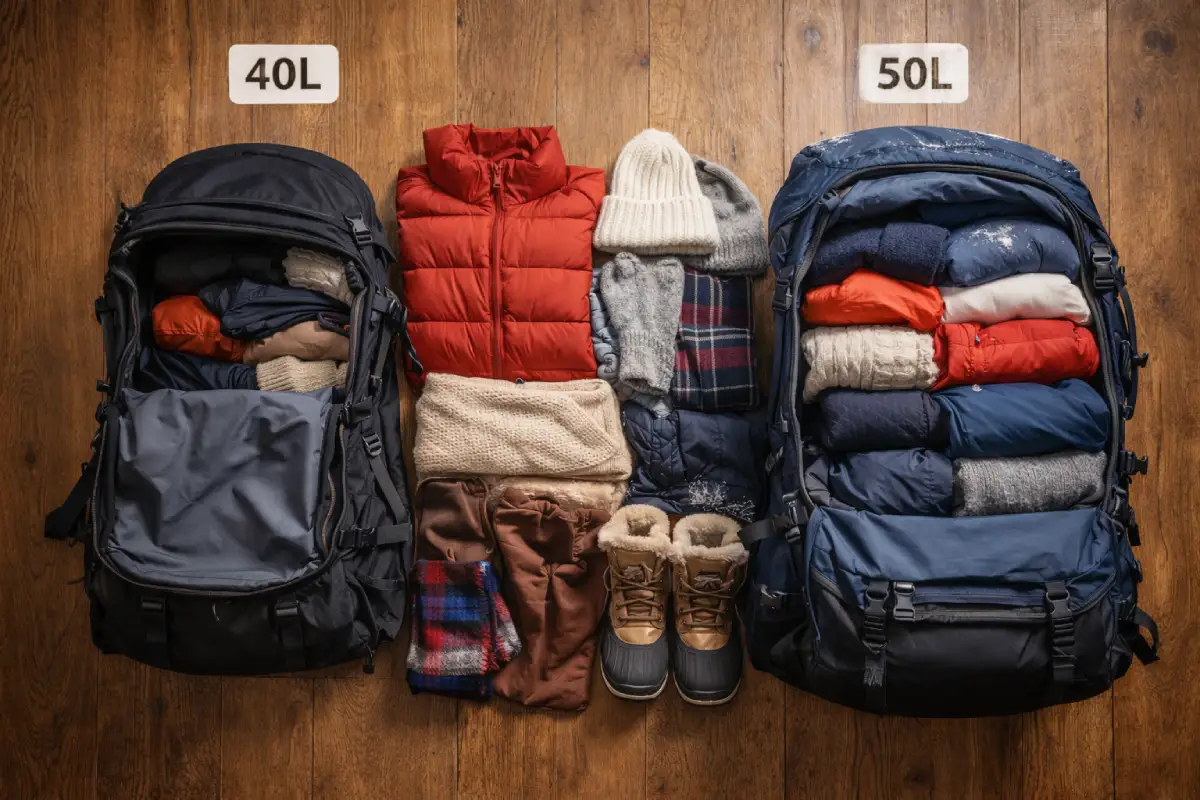
40L in Winter
-
Requires deliberate packing
-
Encourages minimalism
-
Improves mobility
-
Works best for urban travel
-
Requires careful footwear planning
50L in Winter
-
Allows natural clothing expansion
-
Reduces packing stress
-
Supports outdoor gear
-
Suitable for colder climates
-
Less compression pressure
The choice is about friction.
40L reduces friction in movement.
50L reduces friction in packing.
Understanding which type of friction affects your travel style more is key.
Decision Framework: How to Choose the Right Winter Backpack Size
Rather than guessing, use this structured evaluation.
Step 1: Assess Climate Severity
Temperatures slightly below freezing require less volume than sustained sub-zero environments.
If your destination regularly falls below -5°C (23°F), insulation bulk increases significantly.
Step 2: Define Trip Duration
For 3–5 days with laundry access, 40L may suffice.
For 8–12 days without laundry, clothing rotation increases, pushing toward 50L.
Step 3: Identify Travel Style
Urban exploration:
40L usually works.
Ski trips or mountain travel:
50L becomes practical.
Step 4: Consider Airline Compliance
If you strongly prefer carry-on-only travel, 40L is safer under most cabin rules.
If you are flexible with checked luggage, 50L introduces less packing stress.
This decision framework prevents overestimation and underestimation.
Cold Weather Destinations and Volume Demand
Different winter destinations create different volume profiles.
Southern Europe Winter (Rome, Barcelona, Lisbon)
Central Europe Winter (Vienna, Prague, Berlin)
Nordic and Alpine Regions
-
Heavy insulation
-
Thermal layering
-
Winter boots
-
Outdoor gear
In these environments, 50L often becomes the practical choice.
Winter backpack size should match environment intensity.
Winter Carry-On Strategy: Is It Realistic?
Traveling carry-on-only in winter is possible — but it requires adjustment.
Successful winter carry-on travelers typically:
-
Wear outer layers during flights
-
Choose compressible insulation
-
Limit footwear
-
Avoid packing “backup” heavy items
A soft-structured 40L backpack usually has higher cabin acceptance rates than rigid 50L designs.
Winter travel does not eliminate carry-on strategies. It refines them.
Final Verdict: What Size Backpack for Winter Travel?
Winter travel increases packing volume, but it does not automatically require the largest backpack available.
Choose 40L if:
Choose 50L if:
-
Climate is severe
-
Outdoor activities are planned
-
Trip exceeds one week without laundry
-
Packing comfort is prioritized
The right winter backpack size is not about maximum storage. It is about matching insulation bulk to real conditions while preserving travel efficiency.
Winter travel rewards preparation — not excess.
FAQ
1. Is 40L enough for winter travel?
Yes, 40L can be enough for winter travel in mild climates or short trips. It requires disciplined layering, limited footwear, and efficient packing. In colder destinations with heavy insulation, 40L may feel restrictive.
2. Is 50L too big for winter travel?
Not necessarily. For sub-zero climates, outdoor activities, or longer trips without laundry access, 50L provides necessary space and reduces packing stress. However, it may be less convenient for urban mobility and strict airline cabin rules.
3. How much space do winter clothes take in a backpack?
Winter clothing typically occupies 30–50% more volume than summer clothing due to insulation and bulk. Boots and heavy coats are the primary space consumers.
4. Can I travel carry-on only in winter?
Yes, but it requires strategic layering, wearing bulky items during transit, and limiting extra footwear. A well-packed 40L backpack often aligns better with carry-on size restrictions.
5. What size backpack for a 7-day winter trip?
For mild winter conditions, 40L can work with disciplined packing. For colder climates or outdoor activities, 50L provides more flexibility and comfort.
Referans
-
“Cabin baggage—guidance for passengers” — Civil Aviation Authority (CAA), UK Government
https://www.caa.co.uk/passengers/before-you-fly/baggage/cabin-baggage/
-
“Baggage Tips and Carry-On Guidance” — Transportation Security Administration (TSA), U.S. Department of Homeland Security
https://www.tsa.gov/travel/travel-tips/travel-checklist
-
“How to Choose the Right Pack Size” — REI Co-op Expert Advice, REI
https://www.rei.com/learn/expert-advice/backpack.html
-
“Layering Basics: How to Dress in Layers” — National Ski Areas Association (NSAA)
https://www.nsaa.org/
-
“Cold Weather Clothing: Layering Systems Explained” — Outdoor Research Learning / Journal
https://www.outdoorresearch.com/blog
-
“Travel Packing: Packing Light Techniques” — Rick Steves’ Europe
https://www.ricksteves.com/travel-tips/packing-light
-
“Carry-on Baggage Standards” — International Air Transport Association (IATA)
https://www.iata.org/en/programs/passenger/cabin-baggage/
-
“Travel Advice: Winter Travel Safety and Preparation” — UK Government, Foreign travel advice
https://www.gov.uk/foreign-travel-advice
Backpack Size for Winter Travel – Decision Insight
Why does winter travel require a larger backpack?
Winter clothing contains insulation that traps air, increasing packing volume significantly compared to summer garments. Heavy coats, thermal layers, and winter boots reduce usable space inside a backpack much faster than lightweight travel clothing. This makes winter backpack size planning more dependent on bulk than trip duration.
How does climate severity influence backpack size?
In mild winter destinations, a 40L backpack often remains sufficient when layering systems are used efficiently. In sub-zero environments or snow-based travel, additional insulation and gear increase volume demands, making a 50L backpack more practical. Climate intensity directly determines packing margin requirements.
What are the main options for winter travel backpacks?
A 40L backpack prioritizes mobility, airline carry-on compatibility, and efficient urban travel. A 50L backpack prioritizes packing comfort, insulation flexibility, and extended cold-weather trips. The difference is not only capacity but travel experience — one reduces movement strain, the other reduces packing compression.
Consideration: Mobility vs Packing Margin
Winter travel often involves slippery sidewalks, crowded transit systems, and frequent indoor-outdoor transitions. A slightly smaller backpack improves balance and mobility, while a larger backpack reduces internal pressure and organizational stress. The correct winter backpack size is determined by which friction — movement or compression — impacts your travel style more.
Strategic Conclusion
The best backpack size for winter travel is not the largest available, but the one aligned with real climate conditions, clothing system, and movement frequency. For urban winter trips, 40L often delivers efficiency. For alpine or extended cold-weather journeys, 50L provides necessary flexibility. Winter packing success depends on controlled margin, not maximum volume.